
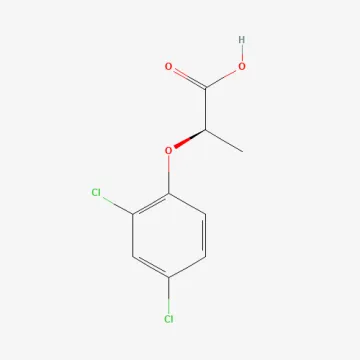
Dichlorprop-P
Description
Mode of action
Dichlorprop-P is an optically active isomer belonging to the phenoxycarboxylic acid family. It acts as a powerful, selective herbicide used primarily in integrated pest management for cereal crops.
The mechanism of action involves mimicking natural plant hormones known as auxins. Once absorbed by the foliage, the active ingredient triggers abnormal cell proliferation, causing the plant tissues to outgrow their vascular supply.
This biological disruption leads to the twisting and curling of stems and leaves, eventually resulting in the collapse of the vascular system and the total inhibition of photosynthesis in target weeds.
As a systemic herbicide, it travels through the weed's vascular system, ensuring that both aerial parts and root systems are affected, which is essential for controlling deep-rooted perennial species.
The substance is known for its high efficiency even at lower dosage rates compared to racemic mixtures. It remains stable on the leaf surface, which provides a consistent window for absorption after application.
What it targets
Dichlorprop-P is primarily used to control a wide variety of broad-leaved weeds in cereal crops, such as wheat, barley, and rye. It is highly valued for its efficacy in diverse agricultural landscapes.
Targeted weeds include species such as Galium aparine (cleavers), Convolvulus arvensis (field bindweed), various Polygonum species, and several members of the Brassicaceae family.
Its ability to tackle tough, resilient weeds like cleavers makes it an essential component of modern herbicide programs. It ensures that the crop can thrive without being outcompeted for nutrients and water.
It is often utilized in tank mixtures with other herbicides to broaden the spectrum of controlled species, offering a comprehensive solution for weed management in commercial agriculture.
Effective control is achieved when the weeds are in their active growth phase, as this is when the metabolic processes are most susceptible to the hormonal disruption caused by the active ingredient.
Rates and timing
Timing is critical for the application of Dichlorprop-P. It should be applied during the active tillering stage of cereals to ensure optimal protection without harming the crop's development.
Application rates depend on the weed spectrum and the density of the infestation. Because Dichlorprop-P is the more active isomer, it often allows for a reduced chemical load per hectare.
Environmental conditions, particularly temperature, significantly influence performance. Applications should be avoided during extreme drought or frost to ensure the weeds can metabolize the herbicide effectively.
When mixing with other products, users should conduct a compatibility test. Proper agitation in the spray tank is required to maintain a uniform solution during the entire application process.
Uniform coverage is vital. Using the correct nozzles and pressure settings ensures that the herbicide is distributed evenly across the weed canopy, maximizing efficacy and reducing drift risks.
Restrictions
The primary restriction is its extreme phytotoxicity to non-target broad-leaved crops. Drift must be strictly controlled to prevent damage to nearby fields of legumes, vegetables, or fruit trees.
Application should be avoided during periods of high wind to prevent the drifting of spray droplets. Weather conditions should be monitored closely before any field operations are initiated.
Operators must wear appropriate personal protective equipment, including gloves and respirators, as the compound can be hazardous if ingested or absorbed through the skin.
Equipment sanitation is mandatory. After application, sprayers must be thoroughly cleaned to prevent cross-contamination, especially if the sprayer will later be used on sensitive specialty crops.
Strict adherence to environmental safety protocols is necessary, including maintaining buffer zones around water bodies and ensuring that no runoff enters local aquatic ecosystems or drainage systems.
Status in the European Union
Approved in the EU
- CAS number
- 15165-67-0
- Approved from
- 01.06.2007
- Approval until
- 31.10.2026
- ADI
- 0.06 mg/kg bw/day
- ARfD
- 0.5 mg/kg bw
- AOEL
- 0.35 mg/kg bw/day
EU status is for reference only and does not replace national registration in your country.