
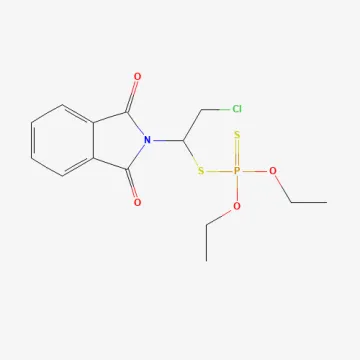
Dialifos
Description
Mode of action
Dialifos is an organophosphate insecticide and acaricide characterized by its contact and stomach action. Its primary mode of action is the inhibition of the enzyme acetylcholinesterase in the nervous system of pests.
By inhibiting this enzyme, the chemical prevents the breakdown of acetylcholine, leading to a build-up of the neurotransmitter at the synapses. This causes continuous nerve impulses, resulting in paralysis and the eventual death of the target insect.
The substance possesses a moderate level of persistence, allowing it to provide a protective residual layer on leaf surfaces. This residual activity ensures effective pest control for approximately 10 to 14 days following application.
Additionally, Dialifos exhibits significant acaricidal properties, making it useful against certain mite species. Its efficacy can depend on the developmental stage of the mite and the specific environmental conditions during treatment.
Due to its ability to penetrate the insect cuticle rapidly, Dialifos provides a strong initial knock-down effect, which is essential for immediate suppression of pest outbreaks in agricultural fields.
What it targets
Dialifos is utilized to control a broad range of chewing and sucking pests on fruit trees, vegetable crops, and industrial crops. It is highly effective against various species of Lepidoptera, Coleoptera, and Hemiptera.
The product is specifically valued for its control over codling moths, leafrollers, aphids, psyllids, and scale insects. It helps significantly in reducing crop damage during critical growth phases.
In orchard management, Dialifos is employed to target overwintering pests, provided that application timing is carefully aligned with the insect's life cycle and plant phenology.
- Leaf-eating caterpillars
- Codling moths (Cydia pomonella)
- Aphids and psyllids
- Scale insects and mealybugs
- Mites (partial efficacy)
To maximize success and protect local ecosystems, it is recommended to integrate Dialifos into an Integrated Pest Management (IPM) program, alternating it with other classes of insecticides to maintain overall effectiveness.
Rates and timing
The application rate for Dialifos varies based on the specific crop, the intensity of the pest infestation, and local climatic conditions. Standard practice involves preparing the spray solution according to the manufacturer's specific labeling.
Applications should be timed based on pest monitoring data, such as pheromone trap results or visual scouting. Uniform coverage of the foliage is essential for the chemical to reach the target insects effectively.
The number of applications per season is generally restricted to prevent the accumulation of chemical residues in harvested products. Strict adherence to pre-harvest intervals is mandatory for food safety.
Spraying should be performed during early morning or late evening hours in calm weather conditions to prevent drift and to avoid chemical degradation from intense UV radiation and high temperatures.
Maintaining optimal temperature conditions during application is crucial, as extreme heat can accelerate the degradation of organophosphates, thereby reducing the intended duration of protective coverage.
Restrictions
Dialifos is toxic to humans and other mammals; therefore, strict adherence to personal protective equipment (PPE) protocols, including respirators, goggles, and gloves, is required during all handling and application processes.
The substance is highly toxic to honey bees and other beneficial predatory insects. Applications during bloom are strictly prohibited to protect pollinators, and neighboring beekeepers should be notified accordingly.
Environmental precautions must be taken to prevent the contamination of water sources, as the chemical is hazardous to aquatic life, including fish and various water-dwelling organisms.
To mitigate the risk of resistance, it is imperative to implement a rotation strategy, utilizing pesticides with different modes of action to ensure long-term pest management sustainability.
Storage must be conducted in original containers within cool, dry, and secure facilities, restricted to authorized personnel and located well away from food, animal feed, and residential areas.
Status in the European Union
Not approved in the EU
- CAS number
- 10311-84-9
- Category (EU)
- IN - Insecticide
EU status is for reference only and does not replace national registration in your country.