
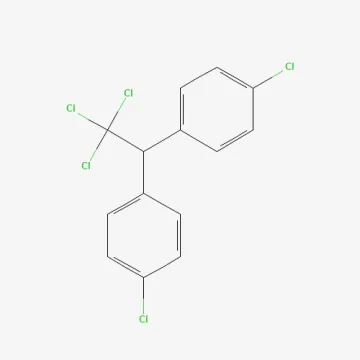
DDT
Description
Mode of action
DDT is a classic organochlorine insecticide that acts primarily through contact. It is famous for its chemical stability, which allows it to remain active on treated surfaces for extended periods.
The mode of action involves the interference with the sodium channels in the nerve cell membranes of insects. By preventing the closure of these channels, the substance induces repetitive nerve impulses, leading to hyperexcitability, paralysis, and death.
As a highly lipophilic compound, DDT easily penetrates the insect cuticle and accumulates in fat tissues. This property made it exceptionally effective but also contributed to its environmental persistence.
The substance does not possess systemic activity, meaning it does not translocate within the plant vascular system. Its efficacy is strictly limited to the areas where the chemical was applied directly.
Over decades of widespread use, many insect populations developed significant resistance to DDT through evolutionary selection, rendering the chemical progressively less effective in field conditions.
What it targets
DDT was historically utilized to control a vast range of agricultural pests, including beetles, caterpillars, and locusts. It provided long-term protection for various crops, such as cotton, corn, and potatoes.
In addition to field applications, it was widely used for protecting stored grains from various pantry pests, offering a long-lasting deterrent effect that few other chemicals could match at the time.
The compound played a crucial role in public health programs, targeting mosquitoes, flies, and ticks. This application was highly successful in eradicating vectors of diseases like malaria and typhus in many regions.
Soil treatments were also common to eliminate subterranean pests, although this method proved to be particularly damaging to soil ecosystems and groundwater quality.
The broad-spectrum nature of the substance allowed farmers to control multiple pests simultaneously, which significantly increased short-term agricultural yields during the mid-20th century.
Restrictions
The use of DDT is strictly banned in agriculture worldwide due to its status as a persistent organic pollutant. It resists degradation, remaining in the environment for decades after initial application.
DDT and its metabolites accumulate in the food chain, causing adverse effects on apex predators, particularly birds of prey, through eggshell thinning and reproductive failure.
According to the Stockholm Convention, the production and use of DDT are severely restricted and restricted solely to disease vector control under specific World Health Organization guidelines.
Monitoring for historical residues is essential in areas with past agricultural usage, as these substances can be taken up by crops or leached into local water sources.
Handling of any remaining DDT stockpiles requires strict adherence to international safety standards for hazardous waste management, emphasizing the prevention of environmental contamination.
Status in the European Union
Not approved in the EU
- CAS number
- See note
EU status is for reference only and does not replace national registration in your country.