
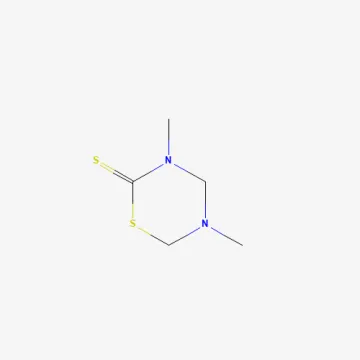
Dazomet
Description
Mode of action
Dazomet belongs to the thiadiazine chemical class and acts as a precursor to methyl isothiocyanate (MITC). Upon contact with moist soil, the active ingredient undergoes hydrolysis to release the fumigant gas.
This gas acts as a potent fumigant with broad-spectrum activity. It rapidly diffuses through the soil pore space, ensuring uniform penetration throughout the treated layer.
The mechanism of action involves disrupting enzymatic processes in target organisms. This leads to the inhibition of respiration and protein synthesis, resulting in the death of soil pathogens.
The efficacy of the treatment is highly dependent on soil temperature and moisture levels. Optimal environmental conditions ensure the effective distribution and activity of the gas.
Following the fumigation period, methyl isothiocyanate gradually degrades into non-toxic compounds, allowing for safe planting after the required waiting period has elapsed.
What it targets
Dazomet is used as a highly effective soil sterilizer to combat a wide range of soil-borne problems. It successfully eliminates harmful nematodes and soil-dwelling insect larvae.
The substance possesses significant fungicidal properties, controlling various pathogens that cause root rots, damping-off, and other soil-borne fungal diseases.
A key feature of dazomet is its herbicidal activity against germinating weed seeds. This significantly reduces weed pressure in the early stages of crop development.
It also targets harmful soil bacteria that can negatively impact vegetable and ornamental crops, providing a clean substrate for root development.
- Parasitic nematodes
- Soil-borne fungal pathogens
- Germinating weed seeds
- Soil-dwelling insect larvae
Rates and timing
Application rates for dazomet vary based on soil type and the degree of infestation. Doses typically range from 300 to 600 kilograms per hectare of treated area.
Application is performed by evenly distributing granules across the soil surface, followed by thorough incorporation into the soil to a depth of up to 20 cm.
Adequate soil moisture (approximately 60% of field capacity) is essential to trigger the chemical reaction that releases the fumigant gas.
To retain the gas in the soil profile, it is recommended to seal the surface using a roller or specialized plastic films immediately after application.
The waiting period before planting or sowing is usually between 2 and 4 weeks, depending on soil temperature and the rate of residual gas dissipation.
Restrictions
Handling dazomet requires strict adherence to safety protocols. The substance is toxic to humans and animals; therefore, the use of appropriate personal protective equipment is mandatory.
Application should never be performed near the root zones of established trees or shrubs, as the fumigant can cause severe damage or death to these plants.
Efficacy is significantly reduced if soil temperatures are below 10°C, as the rate of gas evolution from the active ingredient slows down considerably.
Before planting, it is necessary to perform a residual toxicity test to ensure that the concentration of the fumigant has dropped to safe levels.
When treating greenhouses, proper ventilation must be maintained to prevent the buildup of volatile gases that could be hazardous to operators.
Status in the European Union
Approved in the EU
- CAS number
- 533-74-4
- Approved from
- 01.06.2011
- Approval until
- 31.08.2026
- ADI
- 0.01 mg/kg bw/day
- ARfD
- 0.03 mg/kg bw
- AOEL
- 0.015 mg/kg bw/day
EU status is for reference only and does not replace national registration in your country.