
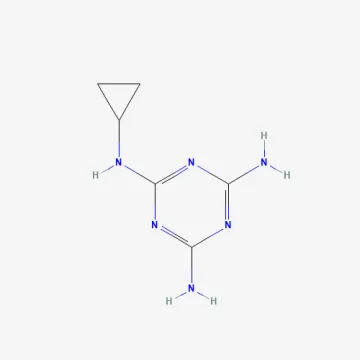
Cyromazine
Description
Mode of action
Cyromazine belongs to the 1,3,5-triazine chemical class and acts as a highly selective Insect Growth Regulator (IGR). Its primary mode of action is interfering with the insect hormonal system, specifically inhibiting development.
The substance disrupts the molting process by interfering with chitin metabolism in larvae. Affected larvae fail to progress to the next developmental stage, leading to their death at the larval or pupal stage.
A key advantage of cyromazine is its high selectivity: it affects only dipteran insects, largely sparing beneficial entomophagous species, which makes it ideal for Integrated Pest Management (IPM) programs.
The active ingredient provides a long-lasting residual effect, allowing for effective control of fly populations for several weeks following a single application to breeding sites.
Depending on the formulation, it can be applied as a contact treatment on surfaces or incorporated into feed or litter, providing comprehensive control of fly populations in livestock facilities.
What it targets
Cyromazine is highly effective against larvae of various fly species, including the house fly, lesser house fly, stable fly, and other synanthropic dipterans.
The product is widely used in poultry farms, livestock operations, pig facilities, and stables where high concentrations of organic waste create optimal breeding grounds for flies.
By specifically targeting the larval stage, the compound prevents the emergence of adult flies, significantly reducing the pest pressure on animals and farm staff.
It is successfully utilized in sanitary programs to prevent myiasis in livestock, a condition caused by parasitic fly larvae.
Furthermore, it is used in greenhouse environments to control leafminers, which damage the foliage of various vegetable and ornamental crops, through soil drenching or spraying.
Rates and timing
Application rates vary depending on the method: when treating manure or litter with a cyromazine solution, the dosage is calculated based on the surface area of the substrate.
When used as a feed additive for poultry, dosage rates are strictly regulated by the product label to ensure no harmful residues remain in the final food products.
Pre-slaughter intervals and withdrawal periods for poultry products must be strictly followed according to the specific product regulations.
For greenhouse crops, applications are timed during periods of peak pest activity, with the frequency of treatment depending on the level of infestation.
Working solutions should be prepared immediately before use, ensuring uniform distribution over the treated area to maximize the insecticidal effect.
Restrictions
Cyromazine does not provide immediate knockdown of adult flies (imagos), therefore, it is often combined with adulticides for rapid reduction of existing fly populations.
Exceeding recommended dosages when used as a feed additive is strictly prohibited to prevent the accumulation of residues in meat or eggs.
Personnel handling concentrated forms of the product must use appropriate personal protective equipment to avoid contact with skin, eyes, and the respiratory tract.
Discharge into open water bodies or drainage systems must be avoided, as the compound can be harmful to aquatic life.
Storage must be in dry, well-ventilated areas, kept separate from food, animal feed, and out of reach of children.
Status in the European Union
Not approved in the EU
- CAS number
- 66215-27-8
- Category (EU)
- IN - Insecticide
- Approved from
- 01.01.2010
- Approval until
- 31.12.2019
- ADI
- 0.06 mg/kg bw/day
- ARfD
- 0.1 mg/kg bw
- AOEL
- 0.06 mg/kg bw/day
EU status is for reference only and does not replace national registration in your country.