
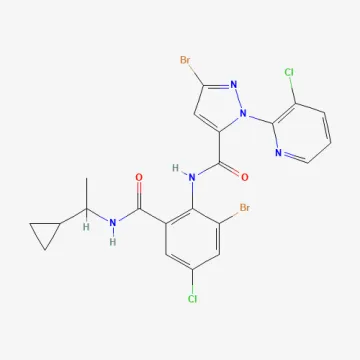
Cyclaniliprole
Description
Mode of action
Cyclaniliprole is a novel active ingredient belonging to the anthranilic diamide chemical class, known for its high potency against a variety of agricultural pests.
Its primary mode of action involves targeting and activating ryanodine receptors within the insect's muscle cells, leading to a sudden release of calcium ions.
This rapid disruption of calcium homeostasis results in muscle paralysis, cessation of feeding behavior, and eventually death, providing effective population control.
The compound exhibits excellent translaminar movement, which allows it to penetrate deep into the leaf tissues and protect the plant from within, including against hidden feeders.
Due to its chemical stability, cyclaniliprole remains active for an extended period, offering durable protection even under fluctuating environmental conditions.
What it targets
This insecticide is primarily targeted at controlling lepidopteran pests, which are among the most destructive categories in global agricultural production.
It is highly effective against a wide range of caterpillars, including various species of armyworms, fruit moths, and leafrollers that threaten yield and quality.
Beyond lepidopterans, cyclaniliprole demonstrates efficacy against specific species of thrips and certain dipteran pests, offering a broader spectrum of control.
The substance is particularly useful for managing larval stages, preventing young pests from causing irreparable damage to crops such as fruits, vegetables, and specialty plants.
- Lepidoptera (moths, butterflies larvae)
- Leafminers
- Various species of thrips
- Specific dipteran pests
Rates and timing
The application rate for cyclaniliprole is strictly determined by the targeted pest species and the crop’s specific growth stage at the time of treatment.
For optimal results, applications should coincide with the beginning of the egg-hatching period to eliminate larvae before they start damaging the plant tissue.
Effective pest management programs often rely on precise timing to maximize the systemic and contact residual activity of the product throughout the growing season.
Proper calibration of spraying equipment is essential to ensure uniform coverage, which is vital for maximizing the insecticidal performance in the field.
When preparing tank mixes, it is crucial to consult product labels for compatibility with other crop protection agents to avoid potential degradation or efficacy loss.
Restrictions
While effective, cyclaniliprole requires careful management to mitigate potential risks to beneficial non-target insects, especially pollinators like bees during blooming.
Users must adhere to mandatory pre-harvest intervals (PHI) to ensure that the final agricultural product meets all food safety regulations and standards.
Strict adherence to personal protective equipment (PPE) guidelines is necessary for all operators to prevent inhalation or dermal exposure during handling and spraying.
To avoid the development of insect resistance, it is recommended to implement integrated pest management (IPM) strategies and rotate chemicals with different modes of action.
All disposal of used containers and chemical residues must be conducted according to local environmental regulations to protect soil and water quality.
Status in the European Union
Not approved in the EU
- CAS number
- 1031756-98-5
EU status is for reference only and does not replace national registration in your country.