
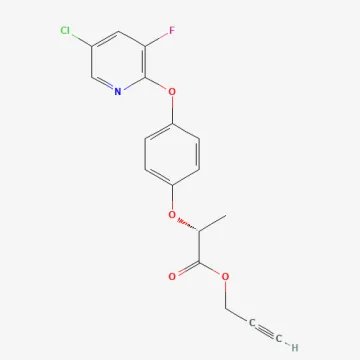
Clodinafop-propargyl
Description
Mode of action
Clodinafop-propargyl belongs to the aryloxyphenoxypropionate chemical family. It acts as a systemic herbicide that is rapidly absorbed through the leaves and translocated to the growing points of the plants.
The mode of action is the inhibition of the enzyme acetyl-CoA carboxylase (ACCase). This enzyme is essential for the biosynthesis of fatty acids, which are building blocks for cell membranes in plant tissues.
When the synthesis of lipids is inhibited, cell division in the meristematic tissues of grass weeds stops, leading to their eventual death within 10 to 21 days.
The compound exhibits high selectivity for grass weeds. Wheat crops are able to tolerate the herbicide because they can metabolize it into inactive compounds very quickly.
A safener, such as cloquintocet-mexyl, is often formulated with the active ingredient to accelerate the detoxification process in the cereal crop, ensuring safety and preventing crop injury.
What it targets
This herbicide is designed to control a range of important annual grass weeds that compete with cereal crops for nutrients, light, and water.
The most susceptible weed species include:
- Wild oats (Avena spp.)
- Foxtail (Setaria spp.)
- Barnyard grass (Echinochloa crus-galli)
- Black-grass (Alopecurus myosuroides)
- Windgrass (Apera spica-venti)
- Canary grass (Phalaris spp.)
Rates and timing
Clodinafop-propargyl is mainly applied to wheat crops during the post-emergence stage. The best results are achieved when weeds are actively growing, ideally between the 2-leaf stage and the tillering stage.
Application rates depend on the specific formulation and the density of the weed population. Consistent coverage using fine droplets is recommended to ensure the herbicide reaches all parts of the target weeds.
Environmental conditions such as temperature and humidity significantly influence performance. Warm, moist conditions promote active plant metabolism, which facilitates rapid herbicide uptake and translocation.
The herbicide breaks down in the soil relatively quickly. Consequently, there are generally no major restrictions on crop rotation following the use of this active substance.
When tank-mixing with broadleaf herbicides, producers must verify chemical compatibility to avoid antagonistic effects that could reduce the efficacy against target grasses.
Restrictions
The primary limitation is the lack of activity against broadleaf weeds. To manage mixed weed populations, it must be tank-mixed with other products that target non-grass species.
Application is restricted to specific cereal crops, primarily wheat. It is generally not safe for use on barley or oats, as these species lack the necessary tolerance mechanisms and may be severely injured.
Avoid applying the herbicide if the crop is stressed due to drought, extreme temperature fluctuations, or pest infestations, as stress may compromise the crop's natural tolerance.
Drift management is essential during application. Herbicide spray should not be allowed to reach nearby susceptible crops, as off-target damage can occur easily under windy conditions.
Users must adhere to all safety protocols, including the use of personal protective equipment (PPE), to prevent exposure during handling and application processes.
Status in the European Union
Approved in the EU
- CAS number
- 105512-06-9
- Approved from
- 01.02.2007
- Approval until
- 31.07.2027
- ADI
- 0.003 mg/kg bw/day
- ARfD
- 0.05 mg/kg bw
- AOEL
- 0.026 mg/kg bw/day
EU status is for reference only and does not replace national registration in your country.