
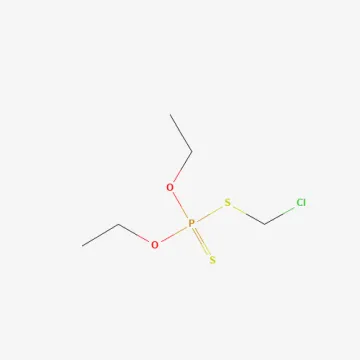
Chlormephos
Description
Mode of action
Chlormephos belongs to the chemical class of organophosphates. By its principle of action, it is a contact and stomach insecticide that effectively affects a wide range of insects.
The primary mechanism of the substance involves the inhibition of the enzyme acetylcholinesterase in the insect's nervous system. This leads to disruption of nerve impulse transmission, causing paralysis and subsequent death of the organism.
The product has high initial activity, allowing for a rapid reduction in pest population density within the root zone of the soil. It lacks systemic action, so its effectiveness directly depends on the quality of application.
An important feature of this compound is its ability to retain toxicity in the soil profile for a certain period, providing protection for crops during critical development phases.
When using chlormephos, it is essential to consider temperature and soil moisture levels, as these factors significantly influence the degradation rate and activity of the active ingredient molecules.
What it targets
Chlormephos is primarily used to control soil pests inhabiting the upper layers of the ground. It demonstrates high efficacy against larvae of various insect species.
- Larvae of scarab beetles (e.g., cockchafers).
- Click beetle larvae, commonly known as wireworms.
- Soil weevils and their larval forms.
- Certain species of cutworms residing in the root zone.
The use of the product is advisable for vegetable crops, sugar beets, corn, and some cereals, where pests cause direct damage to the root system.
Due to its contact nature, the substance is most effective upon contact with the insect's body or when the insect consumes treated particles of the substrate.
This insecticide helps prevent crop thinning and loss of overall productivity in agricultural crops at the beginning of the growing season.
Rates and timing
Chlormephos application rates are strictly regulated and depend on soil type, crop, and expected pest population level. Typically, the product is applied directly to the soil during sowing or planting.
To achieve maximum effect, application should be carried out using specialized applicators that ensure uniform distribution of the product across the treated area.
Application timing is usually tied to the period of soil preparation or the sowing phase, creating a protective barrier around the root system of the young plant.
When calculating dosage, it is necessary to consider the mechanical composition of the soil: on light sandy soils, the rate may be adjusted downward, whereas on heavy loams, the dosage is increased.
Strict adherence to the manufacturer's instructions allows minimizing chemical pressure on the agroecosystem while maintaining the required level of crop protection.
Restrictions
Chlormephos is characterized by high toxicity, requiring strict adherence to safety measures during handling. Personnel must wear personal protective equipment for respiratory, eye, and skin protection.
Application near water bodies is prohibited, as the substance is highly toxic to aquatic fauna, including fish and other hydrobionts.
It is necessary to strictly observe the waiting periods before harvesting to prevent the accumulation of residual amounts of the active ingredient in marketable products.
Restrictions also apply to use in areas with a high probability of pesticide migration into groundwater due to heavy rainfall or irrigation.
The storage of the product must be carried out exclusively in specialized facilities, excluding unauthorized access and environmental contamination.
Status in the European Union
Not approved in the EU
- CAS number
- 24934-91-6
- Category (EU)
- IN - Insecticide
EU status is for reference only and does not replace national registration in your country.