
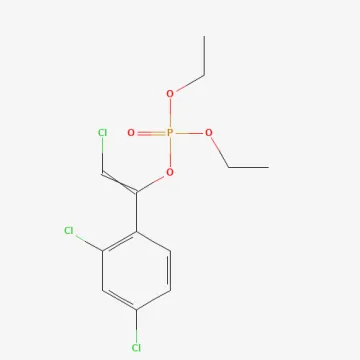
Chlorfenvinphos
Description
Mode of action
Chlorfenvinphos is a synthetic organophosphate insecticide and acaricide known for its potent contact and stomach activity against a wide range of arthropod pests.
The substance functions as an acetylcholinesterase inhibitor. By irreversibly binding to the enzyme, it prevents the breakdown of acetylcholine in the synaptic cleft, leading to continuous nervous stimulation and eventual paralysis of the insect.
It exhibits a moderate level of persistence in the environment, which allows for extended residual control of pests, particularly those residing in the soil or protected habitats.
The chemical is highly effective at killing insects upon direct contact, making it a reliable solution for situations where immediate population suppression is required.
Due to its mode of action, it is categorized as a broad-spectrum insecticide, though it is most frequently utilized for its specific ability to target difficult subterranean species.
What it targets
Chlorfenvinphos is primarily indicated for the control of Coleoptera (beetles) and Diptera (flies) larvae that cause damage to roots, tubers, and underground stems.
It is widely used to protect crops such as carrots, onions, cabbage, and potatoes from major pests like carrot flies, onion flies, and cabbage root flies.
The product serves as an effective soil treatment to combat soil-dwelling larvae, including wireworms and leatherjackets, which can devastate newly germinated crops.
In addition to root-feeding pests, it has been historically deployed to control various mining insects and certain foliar-feeding larvae when population pressures exceed economic thresholds.
While effective against several sucking insects, its primary economic value lies in its reliable control of root-boring and soil-inhabiting pests that are otherwise difficult to manage.
Rates and timing
Application rates for Chlorfenvinphos are strictly dictated by the crop type, soil moisture content, and the specific target pest population density present in the field.
Granular formulations are typically applied directly into the planting furrow or incorporated into the topsoil to create an active zone that prevents pest infestation.
Liquid formulations may be used for drenching or directed spraying, requiring precise calibration of equipment to ensure that the chemical reaches the root zone without wastage.
It is essential to adhere to the designated pre-harvest intervals to ensure that residues in the final food product fall well within established maximum residue limits (MRLs).
- Ensure precise application timing to align with the peak activity of the pest larvae.
- Avoid over-application to prevent soil contamination and phytotoxicity on sensitive young plants.
Restrictions
Chlorfenvinphos is categorized as highly toxic to mammals and non-target organisms, including birds and aquatic life, requiring strict adherence to environmental safety regulations.
Operators must wear full personal protective equipment (PPE), including chemical-resistant suits, gloves, and respiratory protection, during handling and application to prevent hazardous exposure.
Application is prohibited near waterways, and stringent buffer zones must be maintained to prevent runoff and contamination of surface and groundwater supplies.
Its use is increasingly restricted in many jurisdictions due to its toxicological profile and the availability of newer, less persistent, and more selective insecticide classes.
Proper storage is mandatory; the product must be kept in original, labeled containers in a locked, dry, and well-ventilated area away from food, feed, and water sources.
Status in the European Union
Not approved in the EU
- CAS number
- 470-90-6
- Category (EU)
- IN - Insecticide
EU status is for reference only and does not replace national registration in your country.