
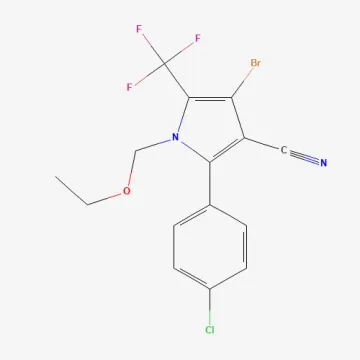
Chlorfenapyr
Description
Mode of action
Chlorfenapyr belongs to the pyrrole class of insecticides and functions as a pro-insecticide. It requires metabolic activation within the target pest, where specific enzymes convert it into its active toxic form.
The primary mechanism of action involves the uncoupling of oxidative phosphorylation in the mitochondria. By disrupting the production of adenosine triphosphate (ATP), the chemical effectively starves the insect of energy at the cellular level.
Due to its high lipophilicity, chlorfenapyr penetrates the insect cuticle efficiently and exhibits significant translaminar movement. This allows the active ingredient to reach pests feeding on the underside of leaves or within plant tissues.
The chemical acts through both contact and ingestion, providing a flexible application method. Its mode of action is distinct from neurotoxic agents, making it a powerful tool for controlling resistant pest populations.
Chlorfenapyr provides a robust and irreversible cessation of pest activity. While the knockdown effect is not instantaneous, it ensures complete population control and prevents further damage to the crop.
What it targets
Chlorfenapyr is widely utilized as a broad-spectrum insect-acaricide, highly effective against various mite species, including spider mites. It is a staple in integrated pest management for greenhouse crops.
Key target pests also include Lepidoptera, such as leafminers, loopers, and various moth species. It is particularly effective in agricultural environments where pests have developed resistance to traditional classes of insecticides.
The substance is commonly applied to ornamental plants, vegetables, and fruit crops grown in protected environments. Its ability to control cryptic pests makes it ideal for managing complex infestations.
By providing a different mode of action compared to organophosphates or pyrethroids, chlorfenapyr is crucial for rotation programs. It prevents the build-up of resistant pest populations and sustains crop yields.
It performs reliably across various environmental conditions, maintaining stability on the plant surface. This durability contributes to longer residual control and reduces the frequency of necessary applications.
Rates and timing
Application rates for chlorfenapyr are tailored to the specific crop, pest pressure, and environmental conditions. Proper calibration of spraying equipment is essential to ensure uniform coverage across all plant foliage.
The best timing for application is at the early stages of pest infestation. Treating before populations reach critical levels ensures better contact and ingestion, maximizing the potential of the active ingredient.
The use of sprayers capable of producing fine droplets is recommended to improve leaf penetration. This is particularly important for plants with dense canopies where hidden pests can evade surface-level chemical contact.
Chlorfenapyr exhibits good stability under various temperatures, which is an advantage in greenhouse settings. Operators should always monitor local weather and environmental constraints before initiating any treatment.
Adherence to labeled dosage rates is critical to avoid phytotoxicity on sensitive plant varieties. Over-application does not significantly improve efficacy and may increase the chemical footprint in the field.
Restrictions
Chlorfenapyr is highly toxic to bees and beneficial predatory insects. Application during the flowering period is strictly prohibited to avoid harm to non-target populations and pollinators.
The substance is hazardous to aquatic life. Strict measures must be taken to prevent drift or run-off into streams, ponds, or drainage systems to protect water quality and aquatic ecosystems.
Personal Protective Equipment (PPE) is mandatory for anyone handling or applying the chemical. This includes protective clothing, gloves, and respirators to prevent dermal contact and inhalation during preparation.
To mitigate the risk of resistance development, growers should strictly rotate chlorfenapyr with insecticides from different chemical classes. A maximum of two sequential applications is generally recommended.
Compliance with pre-harvest intervals is essential to ensure that final produce is free of harmful residues. Operators must strictly follow the legal and technical guidelines provided for each specific crop.
Status in the European Union
Not approved in the EU
- CAS number
- 122453-73-0
- Category (EU)
- IN - Insecticide
- ADI
- 0.015 mg/kg bw/day
- ARfD
- 0.015 mg/kg bw
EU status is for reference only and does not replace national registration in your country.