
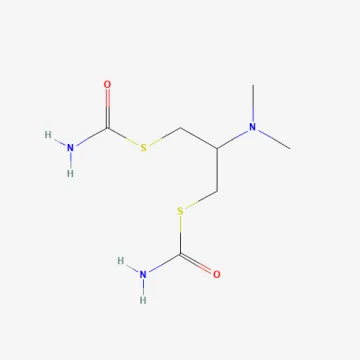
Cartap
Description
Mode of action
Cartap belongs to the chemical class of nereistoxin analogues. It is a highly effective insecticide that acts through both contact and ingestion against a wide range of pests.
The mechanism of action involves blocking nerve impulses in insects. As a nereistoxin analogue, it acts as a neurotransmitter inhibitor, disrupting the cholinergic system of the pest.
Once inside the insect's body, the active substance is converted into nereistoxin, which paralyzes the nervous system. This causes immediate cessation of feeding, followed by paralysis and death within a few days.
Cartap exhibits systemic properties, allowing it to move within the plant tissues. This systemic movement ensures protection for new leaves and parts of the plant that were not directly hit by the spray.
The speed of action is significant; pests typically stop feeding shortly after exposure, which limits immediate damage to crops and preserves plant health.
What it targets
Cartap is primarily used to control lepidopteran pests, including various species of cutworms, leafminers, and borers that attack essential crops.
It is effective against several coleopteran species, such as leaf beetles and weevils, which can cause significant economic losses.
The insecticide is also employed to manage populations of thrips, aphids, and leafhoppers in various agricultural settings, including rice paddies and vegetable farms.
- Rice stem borers
- Cabbage caterpillars
- Potato leaf miners
- Various lepidopteran larvae
Due to its unique mode of action, it is a valuable tool for resistance management programs against pests that have become resistant to organophosphates or pyrethroids.
Rates and timing
Application rates for Cartap depend on the crop type, the target pest pressure, and the specific formulation of the product being used.
In general field applications, recommended rates usually range from 0.5 to 1.5 kg of product per hectare to ensure adequate coverage and efficacy.
Applications should be timed to coincide with the early stages of larval development or when pest populations reach the economic injury level.
For optimal results, consistent and uniform coverage of the foliage is essential, as the systemic activity depends on absorption by the plant.
Adjusting rates based on local environmental conditions and the intensity of pest infestation is recommended for the most cost-effective management.
Restrictions
Cartap is moderately toxic to mammals, requiring strict adherence to personal protective equipment (PPE) guidelines during mixing and application.
The substance is highly toxic to bees and other pollinators; therefore, applications must be avoided during the blooming period of crops.
It is also hazardous to aquatic environments and fish. Applications should be managed to avoid runoff into water bodies, streams, or irrigation canals.
Pre-harvest intervals (PHI) must be strictly followed to ensure residue levels remain within regulatory limits; these typically range from 20 to 30 days.
Avoid application under high-temperature conditions or during strong winds to minimize spray drift and degradation of the active ingredient.
Status in the European Union
Not approved in the EU
- CAS number
- 15263-53-3
- Category (EU)
- IN - Insecticide
EU status is for reference only and does not replace national registration in your country.