
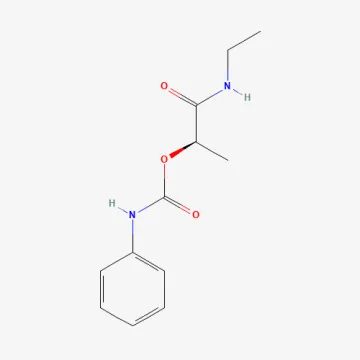
Carbetamide
Description
Mode of action
Carbetamide belongs to the phenylcarbamate chemical class. It functions as a systemic herbicide with selective properties, primarily targeting grasses and certain broad-leaved weeds in various agricultural settings.
The active substance is absorbed mainly through the root system, although it can also be partially taken up by leaves. Once inside the plant, it travels to areas of active growth, known as meristems.
The mode of action involves inhibiting cell division (mitosis). By interfering with the synthesis of essential proteins and nucleic acids, carbetamide halts the growth of susceptible weeds permanently.
The herbicidal effect develops progressively. Shortly after application, treated plants stop growing, show signs of chlorosis, and gradually lose their competitive ability against the main crop.
Carbetamide provides a residual effect in the soil, which is crucial for managing subsequent germination flushes of weed seeds throughout the critical growth stages of the crop.
What it targets
Carbetamide is mainly utilized to control stubborn grass weeds that are difficult to manage with other chemical groups. It is particularly valued in beet and winter crop production systems.
A primary target for this herbicide is Apera spica-venti (common windgrass), a species that often compromises yields in winter cereals and can be difficult to eliminate once established.
It is also highly effective against Alopecurus myosuroides (black-grass), wild oats, and Poa annua. It provides reliable control during the early development stages, preventing severe infestation.
In sugar beet and fodder beet cultivation, carbetamide serves as a specific tool to suppress grass weeds without causing phytotoxicity to the crop itself.
- Apera spica-venti
- Alopecurus myosuroides
- Poa annua
- Avena fatua
Rates and timing
Application rates for carbetamide are determined by weed species, growth stage, and soil type. Typically, rates range between 1.5 and 3.0 kg of active ingredient per hectare.
Soil moisture plays a vital role in efficacy, as the herbicide needs to be absorbed by roots. Optimal results are often seen when soil is moist, facilitating better uptake by young weed plants.
Timing is critical: the product is most effective when applied during the early germination stages of weeds, specifically before or during the emergence of the first leaves.
When incorporating carbetamide into tank mixes with other herbicides, a compatibility test is essential to ensure that the chemical stability of the mixture remains intact.
Application should be performed with calibrated sprayers to ensure uniform coverage, which is necessary to achieve the desired concentration in the soil solution.
Restrictions
Temperature fluctuations can affect the speed of plant metabolism and the rate of herbicide degradation. Performance may be more consistent under moderate temperature conditions.
Application on soils with very high organic matter or peat content is not recommended, as the active substance can be strongly bound to soil particles, reducing its availability to target weeds.
Operators must adhere to strict safety protocols, including the use of personal protective equipment (PPE) such as gloves, goggles, and respirators to prevent accidental exposure.
Environmental safety must be a priority; all application runoff must be kept away from water bodies, drainage channels, and areas near sensitive wildlife habitats.
After finishing the treatment, equipment must be cleaned thoroughly according to established guidelines to prevent contamination in subsequent applications on other crops.
Status in the European Union
Not approved in the EU
- CAS number
- 16118-49-3
- Approved from
- 01.06.2011
- Approval until
- 31.05.2021
- ADI
- 0.06 mg/kg bw/day
- ARfD
- 0.3 mg/kg bw
- AOEL
- 0.12 mg/kg bw/day
EU status is for reference only and does not replace national registration in your country.