
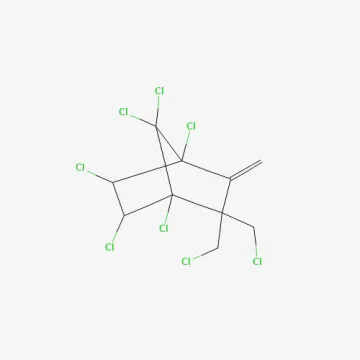
Camphechlor
Description
Mode of action
Camphechlor belongs to the class of chlorinated camphenes and is known as a potent organochlorine insecticide. Its mode of action involves disrupting the nervous system of insects, leading to excitability, tremors, and eventual paralysis.
The substance acts primarily through contact and ingestion, making it effective against a wide variety of crop-destroying pests. Due to its chemical composition, it exhibits significant residual activity on leaf surfaces and soil.
The stability of the compound allows it to withstand environmental degradation, maintaining its insecticidal properties for an extended period under diverse weather conditions.
Despite its efficacy, the molecular structure of camphechlor contributes to its persistence in the environment, which is a major concern for ecological safety and groundwater management.
The biological impact on insects is severe, often preventing the recovery of pest populations for several weeks following a single, well-timed application.
What it targets
This group of chemicals was historically employed to combat a broad range of insect pests, particularly those affecting cotton, cereals, and various industrial crops.
It is effective against various beetles, grasshoppers, and lepidopteran larvae that cause significant yield losses by feeding on foliage and stems.
Camphechlor has been used in large-scale field operations to suppress outbreaks of migratory locusts, helping to protect essential food security crops.
Its use extends to forestry protection, where it has been applied to control defoliating insects that threaten the health and productivity of wooded areas.
However, due to the rapid development of resistance in several target species, the reliance on camphechlor as a standalone solution is strongly discouraged by modern integrated pest management standards.
Restrictions
Camphechlor is highly toxic to mammals, birds, and aquatic life, necessitating extreme caution during handling, storage, and application processes. Specialized personal protective equipment is mandatory for all personnel involved.
Environmental safety regulations strictly prohibit the use of camphechlor near water bodies, wetlands, or areas susceptible to run-off, to prevent catastrophic harm to aquatic ecosystems.
Due to its high toxicity to pollinators, especially honeybees, applications must never be performed during the flowering stage of crops or nearby vegetation.
Strict harvest intervals must be observed to ensure that chemical residues do not exceed the levels permitted for consumer safety, which frequently renders the crop unsuitable for rapid harvest.
International conventions have led to the classification of camphechlor as a persistent organic pollutant, leading to its phase-out or total ban in most global agricultural markets.
Status in the European Union
Not approved in the EU
- CAS number
- 8001-35-2
EU status is for reference only and does not replace national registration in your country.