
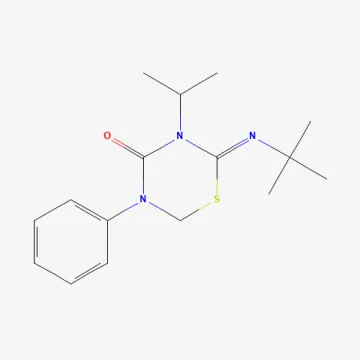
Buprofezin
Description
Mode of action
Buprofezin is a specialized insect growth regulator (IGR) that belongs to the thiadiazine chemical class, widely used in professional agriculture.
The primary mode of action involves the inhibition of chitin synthesis. This disrupts the molting process, preventing larvae from shedding their cuticle and leading to mortality.
In addition to its larvicidal effect, buprofezin suppresses oviposition in adult females and renders laid eggs unviable, significantly reducing the population growth.
It acts primarily through contact and ingestion, showing excellent residual activity that provides long-lasting protection against targeted insect pests.
Buprofezin does not possess systemic properties, which necessitates thorough and uniform application coverage across all parts of the plant canopy.
What it targets
Buprofezin is primarily effective against sucking pests, particularly those from the order Hemiptera that cause significant economic losses in greenhouses and fields.
It is a standard tool for the management of various whitefly species, such as Trialeurodes vaporariorum and Bemisia tabaci, commonly found on vegetables.
The substance provides effective control of leafhoppers, which are major vectors for several plant viruses affecting various horticultural crops.
It is also highly recommended for the suppression of scale insects and mealybugs, which are problematic in fruit orchards and citrus plantations.
The target range includes both larval stages and nymphs, making it an essential component of Integrated Pest Management (IPM) programs.
Rates and timing
Recommended application rates typically range from 0.5 to 1.0 kg of formulated product per hectare, depending on the crop and the density of the pest population.
Applications should be timed to target the early larval stages, as these stages are most susceptible to the insect growth regulation effects of the compound.
Uniform coverage is critical for success; therefore, high-volume sprayers should be used to ensure the solution penetrates dense foliage and reaches the underside of leaves.
When dealing with high pest pressure, buprofezin can be tank-mixed with other insecticides to provide faster knockdown of adult populations.
It is advised to monitor local pest population dynamics to determine the optimal timing for the first application and avoid unnecessary spraying cycles.
Restrictions
Due to its lack of systemic movement, buprofezin will not protect new growth that emerges after the application, requiring repeated treatments if infestation persists.
Resistance management is crucial; users should alternate buprofezin with insecticides featuring different modes of action to maintain efficacy over multiple seasons.
Strict adherence to pre-harvest intervals (PHI) is necessary to ensure that the residues in food crops remain within the legal safety limits for human consumption.
Protective clothing, including gloves and respirators, must be worn during preparation and application to prevent dermal or respiratory exposure to the active ingredient.
The product should be stored in a cool, dry place and kept away from aquatic environments to minimize the risk of runoff and potential impact on non-target organisms.
Status in the European Union
Approved in the EU
- CAS number
- 69327-76-0
- Approved from
- 01.02.2011
- Approval until
- 15.12.2026
- ADI
- 0.01 mg/kg bw/day
- ARfD
- 0.5 mg/kg bw
- AOEL
- 0.04 mg/kg bw/day
EU status is for reference only and does not replace national registration in your country.