
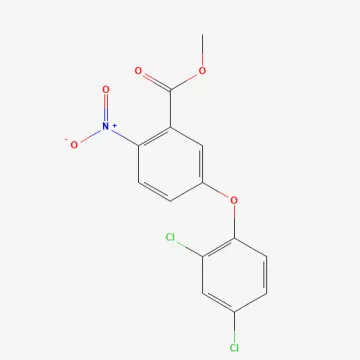
Bifenox
Description
Mode of action
Bifenox belongs to the diphenyl ether chemical class. It functions as a selective contact herbicide, providing effective control over young weeds in the early stages of their development.
The mechanism of action involves the inhibition of the protoporphyrinogen oxidase enzyme within the weed cells. This disruption leads to the cessation of chlorophyll synthesis and the accumulation of toxic metabolic byproducts.
Consequently, the cellular membranes of the weed begin to disintegrate rapidly. Symptoms such as chlorosis and necrosis appear within hours after application, leading to plant death.
Since the compound exhibits minimal systemic movement within the plant, its efficacy depends heavily on the thoroughness and uniformity of the spray coverage on the leaf surface.
The herbicidal activity is significantly enhanced by intense sunlight, which facilitates the photochemical processes that destroy the weed tissues.
What it targets
Bifenox is primarily utilized for controlling a wide variety of broadleaf weeds. Notable targets include common lambsquarters, knotweeds, pigweed, and common ragweed.
The product is widely used in cereal crops and sunflower fields to address populations of problematic weeds that compete with the main crop for resources.
It is particularly valued for its effectiveness against cruciferous weeds, proving to be an essential tool in integrated crop protection strategies.
Bifenox is often employed against weeds that have developed resistance to other herbicide groups, such as sulfonylureas, providing an alternative mode of action.
However, it has limited activity against perennial weeds with deep root systems, as its contact nature prevents destruction of the underground reproductive organs.
Rates and timing
The application rates for Bifenox typically range from 0.5 to 1.5 liters per hectare, depending on the weed species composition and their growth stage.
The optimal timing for treatment is when weeds are at the cotyledon to 4-true-leaf growth stage, where they demonstrate the highest sensitivity to the chemical.
When used in tank mixtures, compatibility must be carefully verified. A small-scale physical compatibility test is recommended to ensure the stability of the spray solution.
Cereal crops are generally treated during the tillering phase. It is crucial to avoid application when crops are under stress due to adverse environmental conditions.
Field application should ideally occur in dry weather conditions with temperatures ranging from 12 to 25 degrees Celsius for maximum efficiency.
Restrictions
Bifenox is toxic to aquatic organisms, and strict precautions must be taken to prevent spray drift and runoff into water bodies or drainage systems.
Special care is required to ensure that spray does not drift onto adjacent non-target crops, which may be sensitive to the herbicide's contact effects.
Operators must wear personal protective equipment, including gloves, goggles, and respiratory masks, to minimize exposure during mixing and application.
Compliance with the specified pre-harvest and grazing intervals is mandatory to ensure food safety and adherence to local agricultural regulations.
The product should be stored in its original, sealed container in a cool, dry, well-ventilated area, safely away from food, feed, and unauthorized persons.
Status in the European Union
Approved in the EU
- CAS number
- 42576-02-3
- Approved from
- 01.01.2009
- Approval until
- 31.03.2027
- ADI
- 0.3 mg/kg bw/day
- ARfD
- 0.5 mg/kg bw
- AOEL
- 0.125 mg/kg bw/day
EU status is for reference only and does not replace national registration in your country.