
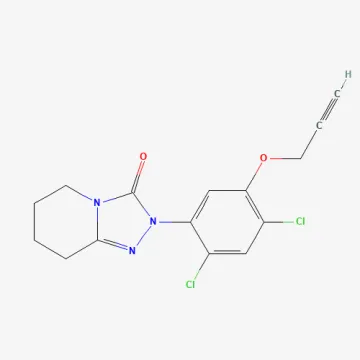
Azafenidin
Description
Mode of action
Azafenidin belongs to the triazolinone chemical class and functions as a selective herbicide by inhibiting the enzyme protoporphyrinogen oxidase (PPO).
By blocking this enzyme, the compound disrupts the chlorophyll synthesis pathway, causing the accumulation of protoporphyrin IX in plant cells.
This accumulation leads to severe oxidative stress, resulting in the rapid destruction of cellular membranes and tissues in sensitive weed species.
The herbicide provides both contact action against emerged weeds and residual activity when applied to the soil surface before germination.
It is valued for its selectivity, allowing it to be used in established vine crops without causing phytotoxic damage to the woody parts of the plants.
What it targets
The primary focus of this herbicide is the control of various annual broad-leaved weeds that compete for resources in permanent crops.
It effectively targets invasive species such as pigweed, lambsquarters, and various knotweed varieties common in agricultural settings.
Used extensively in viticulture to manage ground cover in vineyards, improving water and nutrient availability for the vines.
Additionally, it is utilized in forestry management to suppress weed growth around newly planted tree seedlings to ensure successful establishment.
- Amaranthus retroflexus
- Chenopodium album
- Polygonum species
- Ambrosia artemisiifolia
Rates and timing
Application rates must be adjusted based on soil texture and organic matter content, as higher organic content may bind the active ingredient.
For best results, the product should be applied early in the spring, either pre-emergence or at the very early post-emergence stage of target weeds.
Proper calibration of spraying equipment is essential to ensure an even distribution across the target area while avoiding spray drift onto the vines.
Timing is critical to achieve the desired residual control duration throughout the growing season.
Always adhere to the manufacturer's specific guidelines regarding water volume per hectare to ensure optimal herbicide coverage and soil penetration.
Restrictions
Operators must wear appropriate personal protective equipment (PPE) during mixing and application to prevent dermal or respiratory exposure.
Application should be avoided during high wind conditions to prevent drift that could negatively impact nearby sensitive crops or non-target vegetation.
The environmental impact must be mitigated by preventing runoff into streams, rivers, or other bodies of water to protect aquatic ecosystems.
Crop rotation restrictions should be observed, as residual levels in the soil may affect the establishment of subsequent sensitive crops.
Storage must be maintained in a cool, dry, and secure location, ensuring the original packaging remains sealed to prevent degradation of the active ingredient.
Status in the European Union
Not approved in the EU
- CAS number
- 68049-83-2
EU status is for reference only and does not replace national registration in your country.