
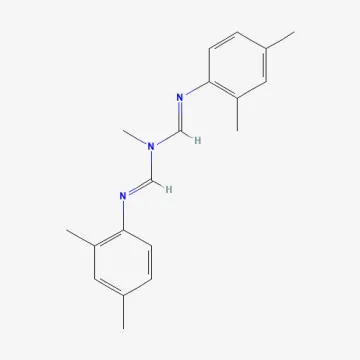
Amitraz
Description
Mode of action
Amitraz belongs to the formamidine chemical class and acts as a powerful contact insecticide and acaricide. The substance disrupts the nervous system of arthropods, causing excitation, paralysis, and eventual death.
The mechanism of action involves interaction with octopamine receptors in the nervous system ganglia of insects and mites. This leads to the disruption of nerve impulse transmission, making Amitraz effective even against populations that have developed resistance to other pesticide classes.
The product exhibits a strong "knockdown effect," rapidly paralyzing pests upon direct contact. Within the pest's body, it blocks essential synapses, effectively stopping vital physiological functions.
For warm-blooded animals, Amitraz is considered relatively moderately toxic, but strict adherence to safety protocols is required during handling. It degrades rapidly in the environment, which minimizes the risk of residue accumulation in agricultural produce.
A key advantage of this substance is its ability to eliminate not only active developmental stages of mites but also to suppress their reproductive capacity, preventing the laying of viable eggs.
What it targets
Amitraz is primarily used to control phytophagous mites (spider mites, gall mites, brown mites) that affect a wide range of agricultural crops.
In veterinary practice and beekeeping, the substance is the gold standard for controlling Varroa destructor mites in honeybee colonies.
It is effective against various scale insects, mealybugs, whiteflies, and certain aphid species found on vegetable, fruit, berry, and ornamental crops.
The substance is utilized in livestock management to treat ectoparasites such as ticks, lice, and mange mites, typically formulated as specialized emulsions.
It is widely used in intensive horticulture to manage pest populations in both open and greenhouse environments where rapid intervention is necessary to contain infestations.
Rates and timing
Application rates vary depending on the specific crop and the target pest. In commercial horticulture, solutions are prepared with concentrations following the manufacturer's specific guidelines.
For beekeeping, specialized formulations are used, such as strips inserted into hives or solutions applied via spray/fumigation during periods when no honey for human consumption is present.
Pre-harvest intervals (PHI) usually require at least 20–30 days to ensure the complete breakdown of the active ingredient and consumer safety.
Working solutions must be prepared immediately before use using clean water, as the stability of the emulsion is highly dependent on the pH level of the water.
The frequency of application per season is limited to prevent the development of pest resistance, as continuous use of a single acaricide reduces its efficacy over time.
Restrictions
It is strictly prohibited to apply Amitraz during the flowering of honey plants if there is a risk to pollinators, unless using specific products approved for beekeeping.
Personnel must wear appropriate personal protective equipment (PPE) for skin, respiratory, and eye protection, and must avoid any contact with the concentrate.
The substance should not be mixed with alkaline pesticides (e.g., Bordeaux mixture), as this will lead to the rapid degradation of the active ingredient.
Application is not recommended during high temperatures (above +25°C) or intense sunlight, as rapid evaporation significantly decreases the product's effectiveness.
Storage conditions must be strictly controlled: avoid direct sunlight and prevent exposure to freezing temperatures, which can cause the emulsion to separate.
Status in the European Union
Not approved in the EU
- CAS number
- 33089-61-1
- ADI
- 0.003 mg/kg bw/day
- ARfD
- 0.01 mg/kg bw
EU status is for reference only and does not replace national registration in your country.