
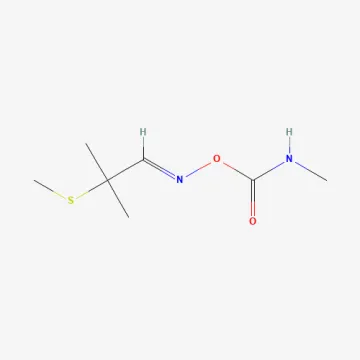
Aldicarb
Description
Mode of action
Aldicarb belongs to the carbamate chemical class and acts as a potent systemic insecticide and nematicide. Its primary mode of action is the inhibition of the acetylcholinesterase enzyme in the pest's nervous system.
The substance is rapidly absorbed by plant roots from the soil and translocated via the xylem to all vegetative organs. This provides a robust systemic barrier against sucking and leaf-eating insects.
Within the insect organism, the accumulation of acetylcholine leads to hyperexcitation of the nervous system, resulting in paralysis and rapid death. The efficacy of the compound persists for a significant period following application.
A notable feature of aldicarb is its ability to act through direct contact and upon ingestion of treated plant tissues. Soil moisture facilitates the gradual release of the active ingredient from the granules.
This mechanism ensures crop protection during the most vulnerable early development stages. The systemic nature of the product allows it to neutralize hidden pests inaccessible to contact insecticides.
What it targets
The primary use of aldicarb is the control of soil-borne pests, including a wide range of nematodes residing in the root zone.
The product is highly effective against aphids, thrips, spider mites, and soil-dwelling insect larvae. It has been successfully employed on vegetable, industrial, and cereal crops.
Applications are most common on potatoes, cotton, sugar beets, and ornamental plants. Its use is justified in regions with high soil infestation density of nematodes.
Aldicarb protects seedlings from early pest colonization, reducing the risk of stand loss and damage to developing crops.
- Soil nematodes.
- Aphids and thrips.
- Spider mites.
- Beetle larvae.
Rates and timing
The product is formulated as granules, which are applied directly to the soil in the row or furrow during planting or sowing of the crop.
Application rates are strictly regulated based on soil type, infestation levels, and the specific crop. Exceeding recommended dosages is prohibited due to significant environmental toxicity.
Application requires specialized equipment that prevents operator contact with the granules. Ensuring uniform distribution within the soil layer is critical for efficacy.
Timing of application is linked to the planting period to ensure maximum systemic activity at the time of initial seedling emergence.
Repeated applications within a single season are generally discouraged to prevent the accumulation of toxic metabolites in the marketable portion of the crop.
Restrictions
Aldicarb is classified as a highly hazardous substance (Category 1) and is extremely toxic to humans, birds, and bees.
The use of this product is heavily restricted or entirely banned in many countries due to the high risk of groundwater contamination and toxicity to mammals.
Manual application is strictly prohibited; the use of closed handling systems and high-level personal protective equipment is mandatory.
Strict adherence to pre-harvest intervals is necessary, as residual amounts can accumulate in fruits and tubers.
The product must not be used in water protection zones, on light sandy soils, or in areas with high water tables.
Status in the European Union
Not approved in the EU
- CAS number
- 116-06-3
EU status is for reference only and does not replace national registration in your country.