
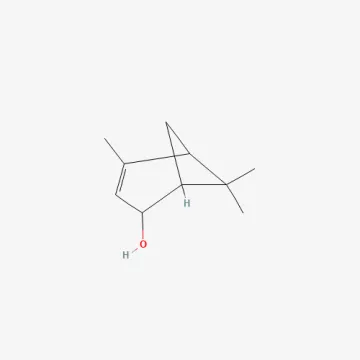
Verbenol
Description
Mode of action
Verbenol is an organic compound belonging to the class of terpenoid alcohols. It is widely recognized as a key component of the aggregation pheromones used by many bark beetle species, particularly those in the genus Ips.
The mechanism of action of verbenol is based on mimicking natural chemical signals that insects use for population communication. In low concentrations, it acts as an attractant, drawing individuals to weakened trees for mass colonization.
In field conditions, synthetic verbenol is used within pheromone dispensers. Its primary function is to disorient pests or concentrate them into traps, which helps to reduce population density in a specific area.
An important characteristic of this substance is its species-specificity. Plants and insects have evolved to recognize specific stereoisomers, making the product highly effective against a narrow range of target pests.
Due to its high volatility, verbenol can quickly create an active pheromone plume around the source, which is critical for the effective monitoring of insect populations in forest areas.
What it targets
The primary targets of verbenol are stem-boring pests of conifers, most notably the spruce bark beetle and other species within the Scolytidae family.
Products based on verbenol are actively used against pests of spruce, pine, and fir trees, which cause significant economic damage to forestry by destroying large tracts of forest stands.
The use of verbenol allows for the effective monitoring and control of insect numbers during periods of mass flight and active breeding phases, helping to prevent outbreaks.
Beyond direct trapping, the substance is indispensable for assessing pest population density, which aids forest pathologists in making timely decisions regarding sanitary logging.
Applying verbenol is most effective in primary infestation sites, where it is necessary to interrupt the bark beetle's breeding cycle before it advances into a large-scale attack on healthy trees.
Rates and timing
Application rates for verbenol are strictly regulated by the instructions provided with specific pheromone products. Typically, one dispenser is designed to protect a specific radius around the trap for the entire flight season.
The timing of trap placement is linked to the pest's phenology: installation should occur in early spring, as soon as temperatures stabilize above freezing, marking the start of the beetles' emergence from hibernation.
It is important to account for evaporation rates, which are temperature-dependent. In hot weather, the effective duration of the bait may be shortened, necessitating replacement according to the product schedule.
To achieve maximum effect during mass trapping, dispensers should be arranged in a grid or along the perimeter of the area at risk of infestation.
Do not exceed the recommended density of traps, as an excessive concentration of pheromones in one location may cause a repellent effect instead of an attractant one, reducing overall control efficiency.
Restrictions
Verbenol requires careful handling as it is a highly active biological compound. Protective gloves should be worn when handling concentrated sources to avoid skin contact.
Products containing verbenol should be stored in airtight containers, in a cool, dark place to prevent premature evaporation of the active component and degradation caused by direct sunlight.
Disposal of used dispensers must be carried out in accordance with chemical waste regulations, ensuring that pheromone residues do not enter water bodies.
The combined use of verbenol with broad-spectrum insecticides is not recommended without consulting an entomologist, as it may interfere with the accuracy of pheromone monitoring results.
This product is intended exclusively for professional forestry use and is not recommended for independent household or garden use without proper training.
Status in the European Union
Not approved in the EU
EU status is for reference only and does not replace national registration in your country.