
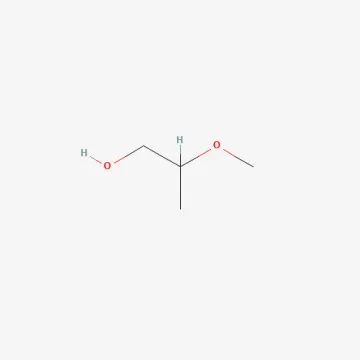
2-Methoxypropan-1-ol
Description
Mode of action
2-Methoxypropan-1-ol serves as a key organic solvent within the glycol ether class, widely utilized in the manufacturing of various plant protection products to ensure optimal formulation performance.
Its primary function is to act as a solubilizing agent, which facilitates the stable dissolution of active ingredients in liquid pesticide concentrates, preventing phase separation.
The compound effectively modifies the physical properties of the spray mixture, enhancing the wetting capability and promoting a uniform distribution of the product across plant surfaces.
By lowering surface tension, it significantly improves the penetration of active components through the leaf cuticle, which is essential for systemic pesticides and contact herbicides.
The addition of this component contributes to the longevity and shelf-stability of the finished product, ensuring that the active ingredients remain effective under varying storage conditions.
What it targets
This substance is not an active ingredient aimed at specific pests or diseases, but rather an enabling agent that optimizes the delivery of various herbicides, fungicides, and insecticides.
It is specifically useful in formulations applied to crops with waxy or pubescent leaves, where efficient droplet adhesion is necessary for successful treatment.
Enhances the efficacy of post-emergence herbicide programs by ensuring the pesticide remains in contact with the weed foliage for the required duration to facilitate absorption.
Supports the action of contact fungicides by ensuring that micro-droplets cover the maximum surface area of the leaf, which is vital for preventing fungal spore germination.
Integral to the formulation of agrochemicals used on high-value crops where consistent and reliable application coverage is required to protect yield quality.
Restrictions
Safety is paramount when handling 2-methoxypropan-1-ol, as it is classified as a hazardous substance that requires careful management to prevent skin, eye, and respiratory irritation.
Operators must utilize appropriate personal protective equipment (PPE), including chemical-resistant gloves, safety goggles, and respiratory masks, especially during the mixing process.
Strict adherence to environmental regulations is required; under no circumstances should wash water or concentrated product be disposed of in surface water systems or sewage lines.
Storage should be conducted in original containers in a cool, well-ventilated area, away from direct heat sources and incompatible chemicals like strong oxidizing agents.
- Use only with adequate ventilation.
- Avoid contact with skin and eyes.
- Implement rigorous waste disposal protocols.
- Check local labels for specific application restrictions.
Status in the European Union
Not approved in the EU
- CAS number
- 1589-47-5
EU status is for reference only and does not replace national registration in your country.