
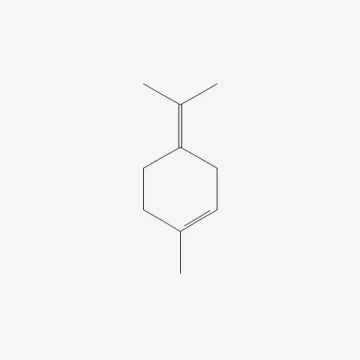
Terpinolene
Description
Mode of action
Terpinolene is a monoterpene hydrocarbon that serves as a key component in many essential oils derived from conifers and various deciduous plants. Within the agricultural sector, it is classified as a naturally occurring biopesticide characterized by high volatility and selective biological activity.
The mechanism of action of terpinolene involves the disruption of the nervous system of target pests. Upon contact with the cuticle of insects or mites, the substance penetrates the exoskeleton and acts on octopaminergic receptors, inducing rapid paralysis and subsequent mortality.
The compound exhibits strong fumigant properties, creating a toxic zone around the treated area that is effective against various pest species. Due to its lipophilic nature, it easily permeates the cellular membranes of parasites, triggering irreversible metabolic processes.
Unlike synthetic insecticides, terpinolene undergoes rapid degradation when exposed to sunlight and soil microorganisms. This property significantly minimizes residual accumulation in soil and crops, making it a favorable choice for integrated pest management (IPM) programs.
The biological efficacy of the product is highly dependent on ambient temperature, as the volatility of the active molecules increases with heat, accelerating the buildup of the concentration levels required for effective disinfestation.
What it targets
In agricultural practice, terpinolene-based formulations are primarily used as contact insecticides and acaricides. They prove effective against a broad spectrum of sucking and chewing pests, including aphids, thrips, and spider mites.
Furthermore, the compound acts as an antifeedant, suppressing the appetite of insects and reducing their damage to young plant shoots. This quality is particularly valuable for protecting crops during periods of intensive vegetative growth.
Terpinolene-based agents are frequently utilized in greenhouses to combat pests on vegetable crops and ornamental plants. In specific instances, the substance is applied to inhibit the growth of certain phytopathogenic fungi during the spore germination stage.
Usage against stored-grain pests helps lower populations of weevils and flour beetles within storage facilities. This makes it a crucial tool for warehouse treatments prior to stocking harvested crops.
An important application involves using terpinolene as an adjuvant component in tank mixtures to improve the penetration of other active ingredients through the plant's waxy cuticle and the protective layers of insect bodies.
Rates and timing
Application rates for terpinolene vary significantly depending on the target organism and the method of delivery. For field crops, fine-droplet spraying is typically employed to ensure complete coverage and wetting of the foliage surface.
When used in greenhouses, applications should ideally be performed during morning or evening hours to reduce the rate of evaporation. It is essential to maintain proper intervals between treatments, considering the pest life cycle to prevent the development of resistant populations.
Pre-harvest intervals for terpinolene-based products are minimal due to the rapid volatilization of the active substance. This allows for applications near the maturation phase of fruits without the risk of exceeding maximum residue limits.
To achieve maximum effect during warehouse treatment, the substance is applied via aerosol fogging. This ensures uniform distribution of the active ingredient throughout the enclosed space, reaching into cracks, crevices, and structural joints.
Agronomists must carefully calculate the application rates based on the plant growth stage, as young tissues may be sensitive to phytotoxicity. A preliminary test on a small plot is strongly recommended to evaluate crop safety before large-scale application.
Restrictions
Terpinolene requires careful handling due to its high volatility and potential to irritate mucous membranes. When handling concentrates, the use of appropriate personal protective equipment (PPE) for respiratory and skin protection is mandatory.
The substance is flammable; therefore, storage must be maintained away from open flames and heating elements. Storage facilities must be equipped with efficient supply-and-exhaust ventilation systems.
Mixing terpinolene with strong oxidizing agents is discouraged, as this may lead to chemical degradation of the active ingredient and a subsequent loss of protective efficacy. Compatibility testing is essential before mixing with other pesticides.
When applying in open fields, wind speed must be monitored to prevent drift toward adjacent areas where beneficial entomophages may be present. Preserving populations of non-target pollinating insects is a priority.
Storage containers must remain airtight to prevent the evaporation of the active component. If the packaging is damaged, the product may lose its insecticidal properties due to gradual oxidation upon exposure to air.
Status in the European Union
Not approved in the EU
- CAS number
- 586-62-9
EU status is for reference only and does not replace national registration in your country.