
Shining flower beetle
Phalacrus politus
Description
How to identify
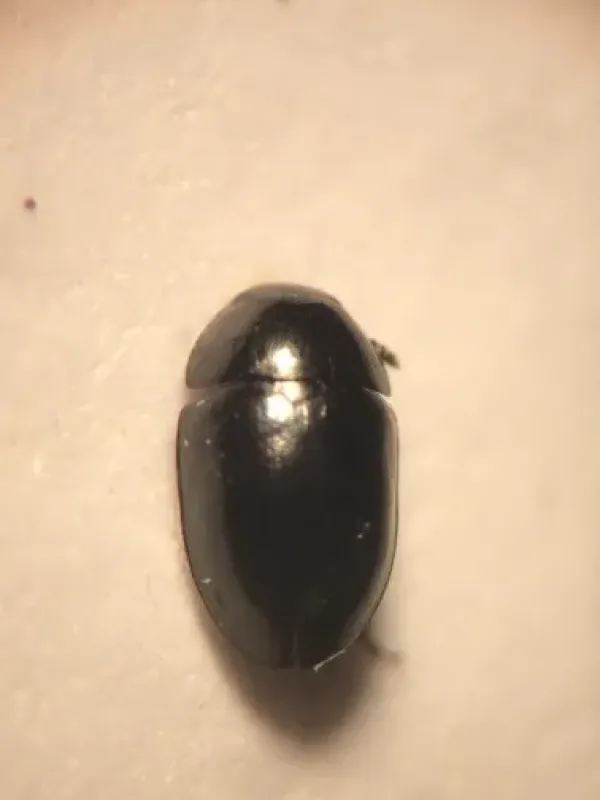
The shining flower beetle (Phalacrus politus) belongs to the order Coleoptera and the family Phalacridae. This small insect typically measures between 1.5 and 2 millimeters in length.
The body of the beetle is distinctly oval and highly convex, resembling a small, dark drop. Its appearance is characterized by a glossy, black or dark brown surface that is smooth and lacks visible punctures on the elytra.
The larvae are white-colored, slightly curved, and possess functional legs, allowing them to move within the flower heads to feed. They are often overlooked during field inspections due to their small size and concealed nature.
Adult beetles are highly mobile and capable of flight, which facilitates their rapid spread across fields when climatic conditions favor their activity.
These insects are naturally occurring in diverse ecosystems but can reach pest status when they aggregate on agricultural crops in significant numbers.
What it damages
The primary damage caused by Phalacrus politus occurs in sunflower fields. Both adults and larvae feed on the inflorescences, consuming pollen and floral tissues, which disrupts the pollination process.
While sunflowers are a preferred host, these beetles may also be found on various other herbaceous plants, where they feed on floral parts or associated fungal spores.
The feeding activity results in the formation of empty or poorly filled seeds, significantly reducing the yield and quality of the sunflower crop.
Injured tissues in the sunflower head create entry points for secondary pathogens, leading to the development of mold and rot, further damaging the crop's economic value.
Mass infestations during the flowering stage are particularly detrimental as the plants are most vulnerable to any disruption of reproductive development.
When it appears
The life cycle of the shining flower beetle is closely synchronized with the phenology of its host plants. Overwintering occurs in the adult stage, typically within the soil or beneath accumulated plant debris.
With the arrival of stable spring temperatures, the beetles emerge and begin their reproductive cycle. The primary period of adult activity and egg-laying coincides with the late spring and early summer months.
Depending on regional conditions, the beetle may complete one or two generations within a single growing season, leading to potential population increases.
Peak abundance usually occurs during the sunflower blooming period, as the availability of pollen serves as a critical food resource for both adults and larvae.
As the season progresses and host plants mature, the beetles begin to search for suitable overwintering sites, often moving to the edges of fields or into forested areas.
Signs of infestation
A primary indicator of infestation is the presence of small, shiny black beetles inside the sunflower heads. They are easily dislodged by gently shaking the flower heads.
Visual evidence includes gnaw marks on the petals and pollen-bearing structures. Damaged flower heads may appear withered or exhibit uneven maturation of seeds.
- Darkening or abnormal moisture in the floral disk.
- Presence of larval excrement within the sunflower head.
- Reduced presence of beneficial insect pollinators in the infested areas.
Field monitoring should focus on assessing the density of beetles per flower head to determine if intervention thresholds have been met.
If the beetles are accompanied by secondary fungal infections, the heads may exhibit discolored patches or signs of premature decay.
Control measures
Effective management begins with cultural practices, such as deep autumn plowing to disturb overwintering sites and reduce the initial population density in the soil.
Maintaining crop rotation and controlling weeds, particularly wild Asteraceae species, helps in reducing the availability of alternative food sources for the beetles.
Chemical control is an option when populations exceed economic thresholds. However, it is essential to use insecticides that are selective and have low toxicity to bees and other essential pollinators.
Integrated Pest Management (IPM) strategies emphasize monitoring fields frequently during the blooming phase to ensure precise timing for any necessary insecticide applications.
By employing edge treatments rather than whole-field applications, growers can manage the pest while minimizing the impact on non-target beneficial insect populations.
Taxonomy
- Latin name
- Phalacrus politus
- Order
- Coleoptera (beetles)
- Family
- Phalacridae
- EPPO code
- PHAAPO
Discussion
No discussions yet — be the first.