
Shining flower beetle
Phalacrus
Description
How to identify
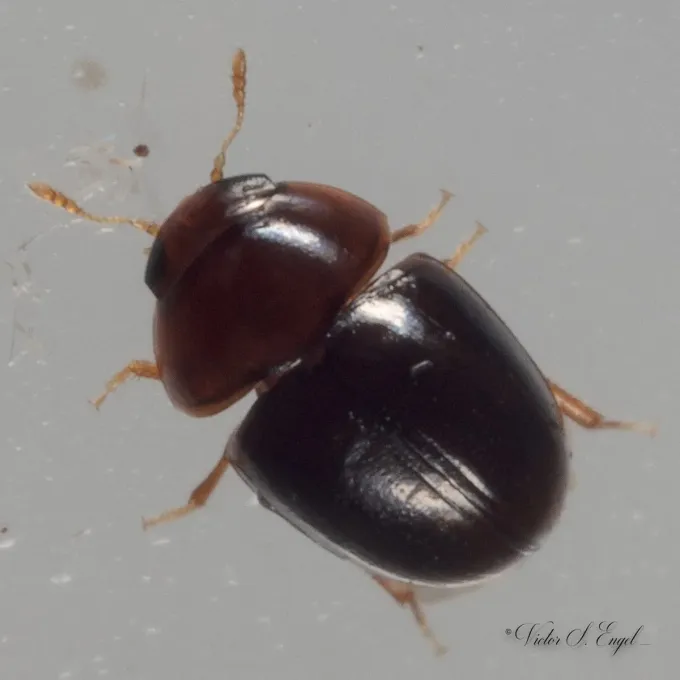
Beetles of the genus Phalacrus belong to the family Phalacridae. Adults have a small body, measuring about 2–3 mm, with a distinctive convex, nearly spherical shape.
The coloration of the insect varies from shiny black to dark brown. The surface of the elytra is smooth, without distinct punctuation, giving the beetle a specific glossy look that reflects light.
The larvae of the shining flower beetle have an elongated, slightly flattened body of white or yellowish color with a distinct chitinized head, adapted for living inside plant tissues.
In natural conditions, the beetles are often found on the inflorescences of Asteraceae plants, where they feed on pollen and fungal spores.
The insect develops through complete metamorphosis, including egg, larva, pupa, and imago stages, which is typical for beetles of this family.
What it damages
The primary food source for larvae and adults of the shining flower beetle is the sunflower head, especially during the flowering and seed formation stages.
The pest actively damages the generative organs of the plant, eating anthers and pollen, which directly affects pollination and reduces the overall seed set of the sunflower head.
The greatest economic damage occurs in years with high humidity, when these insects act as vectors or associates of fungal diseases.
Damaged tissues of the heads become vulnerable to secondary infections, including phoma and gray mold, which exacerbates harvest losses.
When the pest population is high, a decrease in the 1000-kernel weight and deterioration of seed quality are observed, which is critical for industrial oilseed production.
When it appears
The flight of overwintered adults begins in late spring or early summer, usually coinciding with the budding phase of sunflowers.
The peak activity of the pest occurs during the flowering period of the crop, when an abundant supply of accessible food—pollen—is present in the heads.
Reproduction continues throughout the summer period, with generations potentially overlapping depending on weather conditions and the growing region.
In autumn, adults leave the plant heads and migrate to overwintering sites, using plant residues, leaf litter, or the topsoil layer.
Temperature patterns play a key role in population dynamics: a prolonged spring and moderately warm summer promote the mass reproduction of Phalacrus.
Signs of infestation
A primary sign of infestation is the presence of characteristic beetles on the surface of the inflorescences, which often feign death when touched.
Inside the heads, one can find larvae that chew tunnels through the tissues, leading to the premature drying of individual segments of the inflorescence.
Visually, infested heads may appear deformed, with hollow areas where seeds failed to form due to the destruction of the anthers.
Upon inspecting a cross-section of the head, larvae excrement can be observed, along with signs of rot development in the areas where they feed.
An indirect sign is a sharp decrease in pollination quality and uneven seed ripening across the sunflower head area.
Control measures
The main control measure is strict adherence to agronomic standards, including spatial isolation of sunflower fields from wild Asteraceae plants.
Deep autumn plowing helps eliminate a significant portion of the beetle population that has overwintered in the soil or plant debris.
The use of chemical plant protection products is justified only when the economic injury level is exceeded and should be conducted during the peak flight period of the beetles.
It is recommended to use systemic and contact insecticides that are safe for pollinators, applied during the evening hours.
- Timely removal of weed hosts.
- Adherence to crop rotation.
- Use of seeds with high germination energy.
- Monitoring of beneficial entomophages in the agroecosystem.
Taxonomy
- Latin name
- Phalacrus
- Order
- Coleoptera (beetles)
- Family
- Phalacridae
- EPPO code
- PHAASP
Discussion
No discussions yet — be the first.