
Shining flower beetle
Olibrus
Description
How to identify
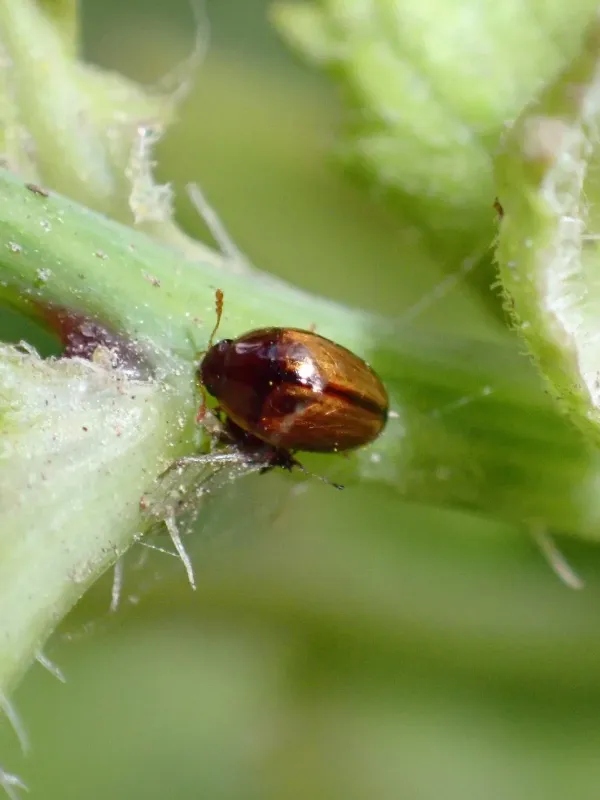
The shining flower beetle (genus Olibrus) belongs to the family Phalacridae, commonly known as shining flower beetles, within the order Coleoptera. These are very small insects, typically measuring 2–3 mm in length.
Adult beetles are characterized by their convex, almost spherical body shape. Their coloration ranges from yellowish-brown to deep black, and they possess highly polished, smooth elytra that give them a distinctive sheen.
The larvae are spindle-shaped and usually whitish or yellowish. They are cryptic insects, as their development takes place within the flower heads of host plants, making them difficult to spot until damage becomes evident.
They are specialized feeders, primarily targeting plants in the Asteraceae family. Their ability to remain hidden inside host structures makes them a persistent pest in certain environmental conditions.
Adults overwinter in plant debris, leaf litter, or the upper soil layer, where they survive the cold season before emerging in the spring to begin a new cycle.
What it damages
The primary agricultural targets for Olibrus are plants within the Asteraceae family, with sunflower being the most commercially significant host crop for this pest.
The damage is primarily caused by the larvae, which burrow into the developing flower heads and consume the seeds (achenes). This feeding directly hinders seed maturation.
Adult beetles feed on pollen and floral tissues, which may weaken the plant's reproductive potential but generally causes less economic damage than the larval feeding activity.
Significant infestations lead to reduced yields, lower seed quality, and potential grain loss during the harvesting phase due to the destruction of the seed contents.
Moreover, the tunnels created by larvae provide entry points for secondary pathogens, such as fungi, which can cause the rot of the sunflower head and further decrease the overall crop harvest.
When it appears
The activity of adults begins in the spring when temperatures rise, allowing them to exit their hibernation sites and seek out suitable host plants for feeding and mating.
Mass emergence and colonization of sunflower fields typically coincide with the budding and flowering stages of the crop, which are the most critical times for potential damage.
The life cycle involves egg, larval, and pupal stages. Larval development occurs within the flower head and lasts several weeks, depending on ambient temperatures and moisture levels.
Pupation often takes place either within the flower head or in the soil, followed by the emergence of a new generation of beetles that continue the cycle until the end of the season.
As autumn approaches and temperatures drop, the adult beetles seek out protective overwintering sites, effectively ending the annual infestation cycle.
Signs of infestation
The first signs of infestation include the presence of tiny exit or entry holes in the outer bracts of the flower heads, created by the larvae.
Observers can detect adult beetles hiding among the florets or pollen during the flowering phase by conducting careful manual inspections of the crop.
A key indicator of larval damage is the discovery of empty, shriveled, or deformed seeds during the cleaning or threshing process after harvest.
Discoloration or premature decay of specific sections of the sunflower head is frequently a sign that larvae have been feeding internally and introducing pathogens.
General crop monitoring during the flowering stage allows agronomists to assess beetle density and determine if the population levels warrant intervention.
Control measures
Effective agrotechnical control starts with deep autumn plowing of the soil, which helps eliminate overwintering sites for the beetles and reduces the survival rate of the population.
Managing weed populations, especially wild species of Asteraceae around field borders, is crucial as these plants serve as primary reservoirs for the beetle.
Chemical control is rarely the first choice and should only be applied if the economic threshold is exceeded during the critical flowering period, strictly following safety protocols for pollinators.
Integrated pest management involves regular field monitoring and the use of targeted applications only when absolutely necessary to protect the sunflower crop.
- Implementation of proper crop rotation.
- Removal of host weeds near fields.
- Deep tillage after harvest.
- Monitoring pest density before applying insecticides.
Taxonomy
- Latin name
- Olibrus
- Order
- Coleoptera (beetles)
- Family
- Phalacridae
- EPPO code
- OLIBSP
Discussion
No discussions yet — be the first.