
Bess beetle
Popilius disjunctus
Description
How to identify
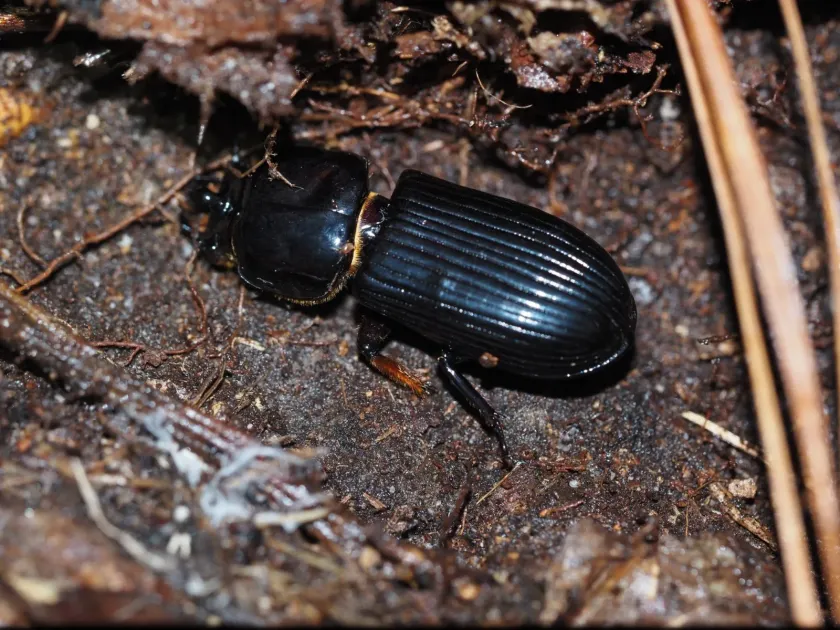
The Bess beetle (Popilius disjunctus), also known as the patent leather beetle, belongs to the family Passalidae. Adults are large, shiny black beetles typically measuring 30–40 mm in length.
They are easily recognized by a small, curved horn on the top of the head and distinct longitudinal grooves covering their elytra. Their body is dorsoventrally flattened to navigate narrow tunnels.
The larvae of this species are C-shaped, creamy white, and possess a robust set of mouthparts. Unlike most other beetles, the larvae and adults coexist within the same gallery systems.
Bess beetles are famous for their subsocial behavior. Adults actively participate in the care of their larvae, including preparing and pre-digesting woody substrate for them to consume.
These insects are primarily found in moist, temperate forest ecosystems. In agricultural settings, they are associated with rotting logs or decaying wood debris.
What it damages
The diet of the Bess beetle consists strictly of decaying hardwood, such as oak, elm, or beech. They are classified as obligate saproxylic insects.
In natural habitats, they provide a vital service by breaking down dead wood and returning nutrients to the soil. They pose no threat to healthy, living trees.
Damage occurs when these beetles infest lumber used for garden construction, plant stakes, or trees that have already been weakened by rot or fungal pathogens.
Their tunneling activity compromises the structural integrity of the wood, causing it to become brittle and eventually fail under weight or wind pressure.
While they do not kill healthy plants, their presence in structural timber can lead to expensive repairs if the wood is allowed to become excessively damp and decayed.
Signs of infestation
Signs of infestation include clean, circular exit holes in the wood surface, usually around 5 to 8 mm in diameter.
Small piles of "frass"—a mixture of wood dust and beetle excrement—are often visible near the entry points or at the base of the infested wood.
Removing a section of bark or splitting the wood reveals extensive, organized galleries following the grain of the wood.
Adult Bess beetles produce audible chirping sounds, created by rubbing their wings against their abdomen, which can sometimes be heard when disturbances occur.
Visible surface mold or wood discoloration is frequently associated with the presence of these beetles, as they carry fungal spores that aid in wood decomposition.
Control measures
The primary control measure is site sanitation. Remove all decaying logs, old stumps, and dead wood piles that could serve as breeding grounds for the beetles.
Ensure that structural garden timber is kept dry and off the ground. Using pressure-treated lumber or sealing wood with high-quality preservatives prevents the moisture levels required by the beetle.
Maintain the health of ornamental trees in the garden. Since the beetles prefer decaying wood, keeping trees free from fungal infections minimizes the risk of attraction.
If wooden garden structures are heavily infested, the affected components should be removed and disposed of to prevent further spread.
Chemical control is rarely necessary for this species, as physical removal of the damp wood source is sufficient to eliminate the colony from the area.
Taxonomy
- Latin name
- Popilius disjunctus
- Order
- Coleoptera (beetles)
- Family
- Passalidae
- EPPO code
- ODOADI
Discussion
No discussions yet — be the first.