
Passalid beetle
Odontotaenius
Description
How to identify
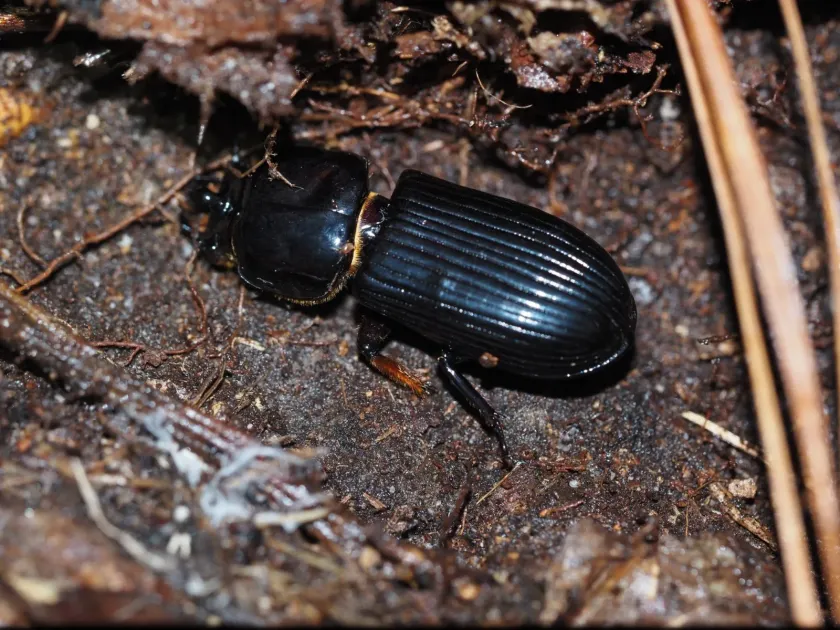
Passalid beetles (family Passalidae) are large insects, often reaching 30–40 mm in length. A defining characteristic is the presence of powerful mandibles and a prominent horn on the head, which is particularly distinct in the genus Odontotaenius.
The body of these beetles is strongly flattened, allowing them to move easily through narrow galleries bored into rotting wood. Their coloration typically ranges from dark brown to coal-black, often with a glossy sheen.
Larvae are C-shaped with a whitish body and a darker head capsule. Unlike the larvae of many other scarab beetles, they live in highly socialized colonies within decaying wood, where they are protected from the environment.
A key biological feature is their complex social behavior: adults exhibit parental care, actively preparing the woody substrate by chewing it to make it more digestible for their larvae.
Systematically, this object belongs to the order Coleoptera and the family Passalidae. While they serve as essential decomposers in forest ecosystems, they can become an agronomic concern in neglected or aging orchards.
What it damages
Passalid beetles are not primary pests of healthy living trees; their activity is centered on decomposing, weakened, or dead wood. In an agronomic context, they pose a risk to old fruit orchards where stumps and fallen timber remain.
These insects prefer to infest deciduous trees, including apple, pear, and various stone fruits. They create extensive tunnel systems in the trunks, which leads to the rapid structural degradation of the wood.
Damage manifests as a loss of mechanical integrity in trees. If a tree has been previously compromised by fungal infections or rot, passalid beetles accelerate the breakdown process, making the trunk brittle and susceptible to wind damage.
For commercial plantations, the risk lies in the creation of colonization sites within wood remnants left after clearing operations. Failure to promptly remove stumps creates an ideal environment for these beetles to thrive.
In mass infestations within older trees, passalid activity can contribute to branch dieback by disrupting nutrient flow due to damage to the tree's conductive tissues.
When it appears
Adult activity of Odontotaenius is observed primarily during the warmer months, from late spring through mid-autumn, when beetles are most active in searching for suitable sites for oviposition.
The development cycle of passalid beetles is protracted because they develop within wood, where the microclimate is relatively stable throughout the year. Adult beetles can remain in their tunnels during the winter months.
Mating and intense colonization usually coincide with rising environmental temperatures. Larvae develop over several months, progressing through multiple instars within the decaying logs or stumps.
Overwintering occurs directly within the substrate, such as rotting stumps or fallen logs, which provides protection against freezing soil temperatures and harsh weather conditions.
Agronomists should monitor the condition of older trees during the summer, looking for new exit holes in the bark and the presence of wood frass at the base of the trunks.
Signs of infestation
The first sign of passalid presence is the appearance of characteristic, relatively large exit holes in the bark or trunk. The diameter of these holes typically corresponds to the size of the adult beetle.
The presence of fine wood dust and excrement (frass) at the base of the tree or on the surface of the bark is a direct indicator of insect activity inside the trunk.
Upon visual inspection of weakened trees, one may notice bark loosening, revealing complex branching tunnels underneath. Inside these tunnels, one often finds a specific substrate processed by adults for larval feeding.
Audible signals produced by the beetles (stridulation) can sometimes be heard in quiet conditions if the population within a tree is significant. This serves as a reliable, albeit indirect, sign of infestation.
A decline in the tree's overall vigor, early yellowing of foliage, and structural fragility during high winds indicate hidden damage to the tree's integrity by wood-boring insects.
Control measures
The primary method for managing passalid beetles is the implementation of strict sanitary practices in the orchard. Regular removal of stumps, deadwood, and severely damaged trees eliminates the pest's food source.
If colonization sites are detected, radical removal of affected tree parts is necessary. If a tree is heavily infested, it is recommended to cut it down and properly dispose of the debris by burning or moving it far from the site.
Chemical control against passalid beetles is largely ineffective due to the insects' hidden lifestyle inside the wood. Systemic insecticides should only be used as a preventative measure for healthy trees at risk.
It is recommended to maintain high standards of orchard management, ensuring trees receive adequate nutrients and hydration. A healthy tree with vigorous sap flow possesses natural resistance to colonization by most wood-boring species.
- Timely stump removal.
- Sanitary pruning of deadwood.
- Maintaining health of fruit crops.
- Use of pheromone traps (if specific attractants are available).
Taxonomy
- Latin name
- Odontotaenius
- Order
- Coleoptera (beetles)
- Family
- Passalidae
- EPPO code
- ODOASP
Discussion
No discussions yet — be the first.