
Warehouse cabinet beetle
Trogoderma variabile
Description
How to identify
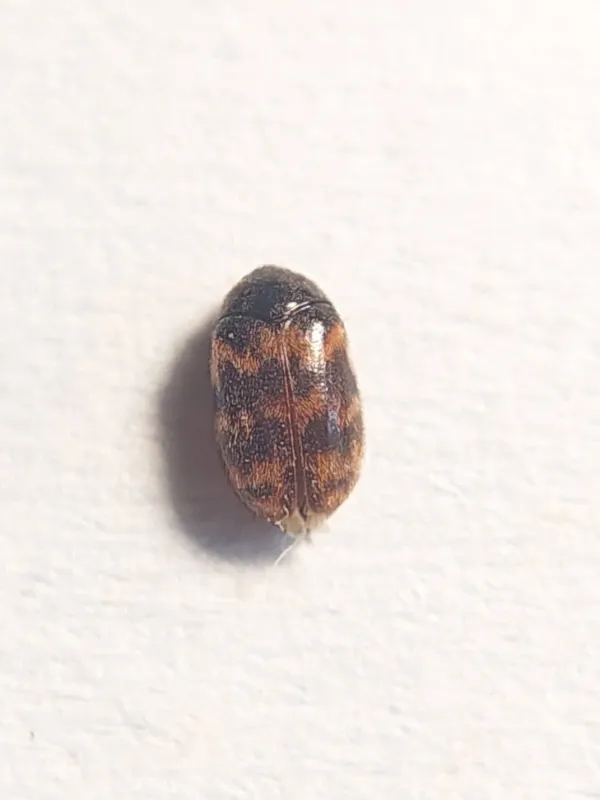
The warehouse cabinet beetle (Trogoderma variabile) belongs to the family Dermestidae, the order Coleoptera. Adult beetles are small, ranging from 2.5 to 4 mm in length, with an oval-shaped body covered in fine brown or black hairs.
Larvae are more distinct, featuring an elongated body covered with dense bristles, which form a characteristic tail-like tuft at the end of the abdomen. Their color ranges from light yellow to reddish-brown.
The lifecycle consists of egg, larva, pupa, and adult stages. Under optimal conditions, the cycle is completed in 30–40 days, but larvae can enter diapause for extended periods under adverse conditions.
Females lay eggs directly onto food sources, ensuring immediate access to nutrients for emerging larvae. A single female can produce over 100 eggs during her lifespan.
This beetle is a serious pest of global concern, capable of hitchhiking through international trade in contaminated transport containers and packaging materials.
What it damages
These pests target a wide range of stored products, including grains like wheat, barley, corn, rice, and oats, as well as various processed goods.
Significant damage is frequently reported in stored flour, cereal products, pasta, animal feed, and bran. They also thrive in nuts, dried fruits, and oilseeds kept in storage.
In warehouse environments, the larvae do not only consume the primary product but also damage packaging and storage bags, creating entry points for secondary infestations.
The larvae are the primary cause of destruction; they bore into the products, leaving behind hollowed kernels, dust, larval exuviae (shed skins), and fecal matter.
Economic losses can be substantial, as their hidden feeding behavior often makes detection difficult until a large portion of the stored inventory has been compromised.
Signs of infestation
The most common sign of an infestation is the presence of cast larval skins scattered throughout the stored product or along the seams of storage containers.
Inspectors often find fine dust, excrement, and seeds that appear hollowed out or damaged, which are classic indicators of an active cabinet beetle colony.
Infested materials may develop a musty odor, and in high concentrations, the activity of the larvae can cause the grain to heat up, potentially leading to mold growth.
Adult beetles may be observed crawling on walls, near cracks in floorboards, or on the surface of grain stacks during peak activity seasons.
The use of pheromone traps is the industry standard for detecting populations early, allowing for targeted intervention before major damage occurs.
Control measures
Successful management begins with strict quarantine and inspection protocols for all incoming agricultural goods and storage supplies.
Sanitation is a critical control measure; warehouses must be thoroughly cleaned of grain dust, spills, and debris where larvae and pupae might harbor between batches.
Surface treatments with approved residual insecticides (wet disinfestation) can help manage beetle populations by targeting cracks, crevices, and hiding spots within the warehouse structure.
For heavy infestations within stored commodities, professional fumigation is required to ensure the gases penetrate deep into the grain mass to eliminate all life stages.
Maintaining cool storage temperatures is highly effective, as the development and reproduction of Trogoderma variabile slow significantly below 15 degrees Celsius.
Taxonomy
- Latin name
- Trogoderma variabile
- Order
- Coleoptera (beetles)
- Family
- Dermestidae
- EPPO code
- TROGPA
Discussion
No discussions yet — be the first.