
Grassman dermestid beetle
Trogoderma grassmani
Description
How to identify
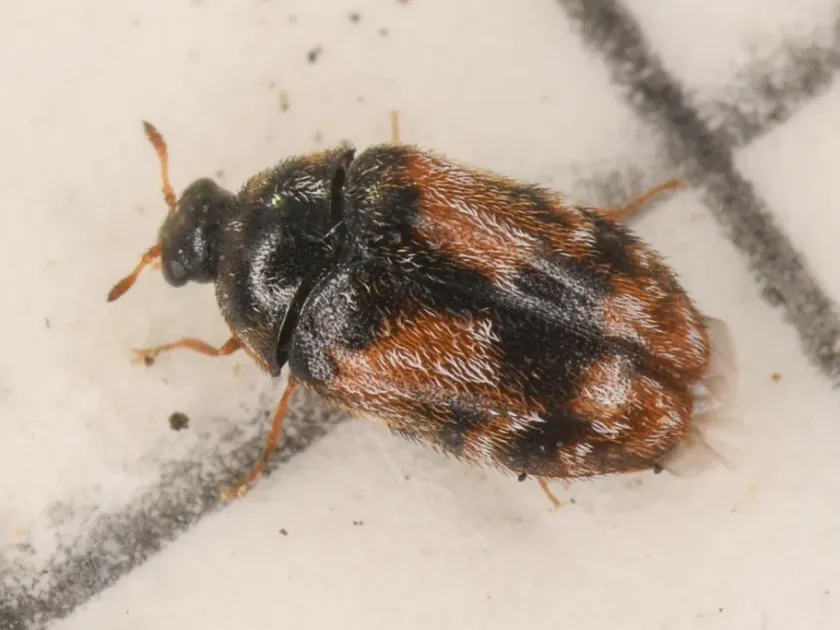
The Grassman dermestid beetle (Trogoderma grassmani) is a small insect belonging to the family Dermestidae, within the order Coleoptera. Adult beetles are typically oval-shaped, ranging in size from 2 to 4 millimeters.
The coloration of the adult usually ranges from dark brown to black, often featuring specific patterns of pale scales on the elytra. The larvae are more distinctive, characterized by dense hair covering their segmented bodies and a reddish-brown appearance.
This species is highly resilient, capable of surviving in environments with low humidity and limited food sources. Accurate identification often requires expert microscopic examination of larval morphology or adult genitalia due to the similarities with other Trogoderma species.
They are typical indoor inhabitants, well-adapted to grain elevators, warehouses, and storage facilities containing food products. Their small size allows them to infiltrate even the narrowest cracks and structural joints within storage units.
The lifecycle consists of egg, larval stages, pupa, and adult. Under favorable temperature conditions, the development from egg to adult occurs rapidly, enabling the population to increase significantly in a short period of time.
What it damages
The Grassman dermestid beetle causes substantial damage to stored agricultural products. Their diet includes various seeds, cereal grains, legumes, dried fruits, flour, and processed feed products of both plant and animal origin.
Larvae are particularly damaging as they consume the interior parts of grain kernels, including the germ. This behavior leads to massive weight loss in stored stock and a sharp decline in the germination rate of seed batches.
Beyond direct consumption, the pest contaminates products with frass, cast-off larval skins, and webbing. These contaminants render the product unfit for human or animal consumption due to health risks and quality degradation.
The beetle often colonizes residues left in cracks, beneath floorboards, or in corners of grain warehouses. These hidden reservoirs serve as constant sources of infestation for newly arrived harvests, making total eradication difficult.
In large-scale storage facilities, this species can turn high-quality grain into waste within months, especially when moisture levels and temperatures are not strictly managed. Financial losses due to downgraded or rejected products are significant.
When it appears
As a storage pest, the Grassman dermestid beetle is active year-round within climate-controlled storage environments. Its lifecycle is governed more by the internal microclimate of the warehouse than by external seasonal changes.
Optimal reproduction and activity usually occur during the spring and summer months when ambient warehouse temperatures rise between 25 and 30 degrees Celsius. Warmth significantly boosts their metabolic rate and accelerates the larval development cycle.
During colder months, if the storage facility is not heated, the pest may enter a state of dormancy or diapause. However, in modern facilities with climate control, the infestation can persist and grow continuously throughout the winter.
Mass appearance of adults is often observed when fresh grain is brought into a facility that was not properly sanitized. Moderate humidity levels in the storage area are preferred, providing an ideal environment for larval growth and survival.
Monitoring for this pest should be conducted consistently, particularly in late winter and early spring, to catch burgeoning populations before the peak storage season begins.
Signs of infestation
The most common sign of infestation is the presence of fine, powdery dust mixed with larval skin fragments on the surface of grain heaps. This accumulation indicates that the larvae are actively molting and growing.
Visible movement within the grain mass or the presence of beetles on warehouse equipment and walls suggests a heavy infestation. Larvae are often found clustered in dark, quiet areas like the folds of packaging sacks.
A musty or stale odor emanating from a grain batch is a warning sign of contamination. This odor is caused by the activity of the larvae and the subsequent growth of fungi in the areas where the grain has been damaged.
The use of pheromone traps provides a reliable detection method, catching adults and confirming the presence of the beetle before visible damage appears. Regular inspection of packaging and sampling of grain depth is essential.
Sifting grain samples through fine-mesh screens will easily reveal the presence of larvae and frass. This diagnostic step is a mandatory part of quality control procedures for any professional grain storage operation.
Control measures
Sanitation is the cornerstone of control for the Grassman dermestid beetle. Rigorous cleaning of warehouses, removal of grain dust, and elimination of old residue deprive the beetle of food and breeding sites.
Fumigation using phosphine-based treatments remains the most effective chemical method for eradicating all life stages of the beetle, including eggs and larvae hidden deep within building structures.
Integrated Pest Management (IPM) practices, including the use of pheromone traps, allow managers to track pest numbers and apply precise control measures only when necessary, reducing the need for broad-spectrum chemical use.
- Sealing all structural cracks and entry points to prevent new infestations.
- Maintaining grain moisture content below 14% to inhibit larval development.
- Conducting thorough disinfestation of empty storage bins before accepting new harvest deliveries.
Should an infestation occur, rapid isolation of the affected batch is critical. Proper professional treatment and adherence to hygiene standards ensure long-term protection of the stored harvest and prevent major economic losses.
Taxonomy
- Latin name
- Trogoderma grassmani
- Order
- Coleoptera (beetles)
- Family
- Dermestidae
- EPPO code
- TROGGS
Discussion
No discussions yet — be the first.