
Smooth dermestid
Trogoderma glabrum
Description
How to identify
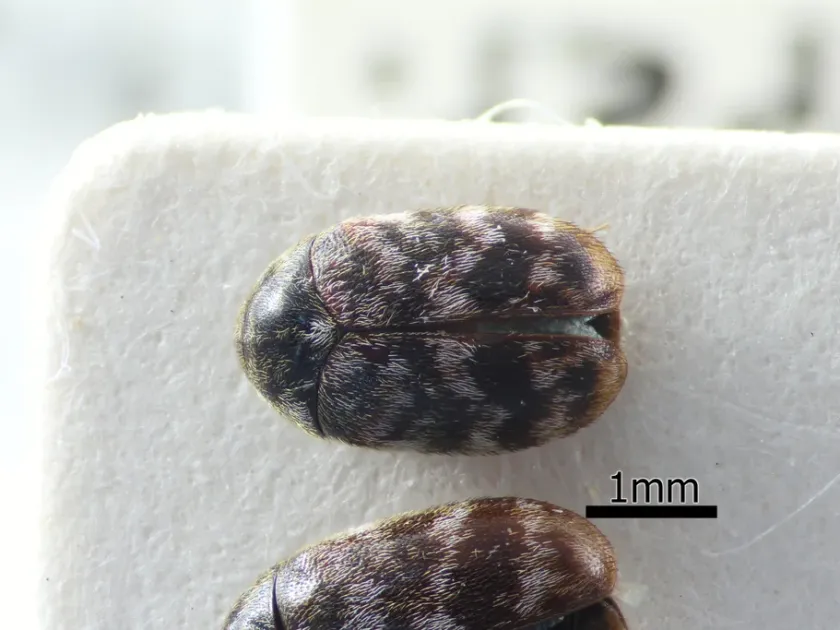
The smooth dermestid (Trogoderma glabrum) is a significant pest belonging to the Dermestidae family and the order Coleoptera. Adult beetles are small, oval, and slightly convex, typically measuring between 2.5 and 4 mm in length.
The adults are dark brown to black in color, often featuring indistinct lighter patterns on their elytra. A key diagnostic feature is the small head, which is partially retracted into the pronotum, typical of the Trogoderma genus.
The larvae are more easily detected than the adults; they are covered in dense, long hairs, giving them a distinctive "fuzzy" appearance. Their color ranges from light yellow to reddish-brown depending on their developmental stage.
The life cycle undergoes complete metamorphosis, including egg, larval, pupal, and adult stages. Adult beetles have a short lifespan and focus primarily on reproduction, causing negligible damage compared to their larval stage.
This species is a quintessential inhabitant of warehouses, grain elevators, and food storage facilities, where it thrives in protected environments with consistent temperatures and food availability.
What it damages
The smooth dermestid is a specialized pest of stored products, damaging a wide variety of plant and animal materials. It is the larvae that cause the most severe economic damage due to their strong, chewing mouthparts.
Commonly attacked commodities include cereal grains such as wheat, barley, corn, millet, and oats. Larvae selectively feed on the germ and endosperm of the grain, turning the kernels into hollowed-out debris and contaminating them with excrement.
Beyond whole grains, the pest also infests flour, cereals, animal feeds, and processed food products. They are also frequently found in oilseeds, dried fruits, and various dried vegetable products.
This beetle is highly adaptable and can develop in products with relatively low moisture content. Under optimal conditions, a large infestation can destroy an entire inventory within a very short timeframe.
Infestation leads to significant weight loss and severe quality degradation. The presence of larvae causes clumping, mold growth, and increased moisture, rendering the grain unsuitable for human consumption or processing.
When it appears
In temperature-controlled storage facilities, the smooth dermestid can reproduce throughout the year, provided temperatures remain above 15–20 degrees Celsius. They are highly successful in stable indoor environments.
Optimal development occurs between 25 and 30 degrees Celsius. Under these conditions, the complete life cycle from egg to adult is finished in approximately 1.5 to 2 months, allowing for several generations per year.
In non-heated warehouses, the beetle's activity is seasonal, peaking from late spring through autumn. Larvae typically overwinter in cracks, crevices, and structural gaps within the storage facility.
Development slows significantly below 10 degrees Celsius, but the larvae are hardy and can survive extended periods of cold, resuming activity once temperatures rise again.
The movement of infested shipments is a critical factor in the pest's spread, as new infestations are often introduced into clean facilities via raw materials at any time of year.
Signs of infestation
Detecting a smooth dermestid infestation involves looking for specific signs of insect activity. The most common indicator is the presence of cast larval skins (exuviae) accumulating in corners, floor cracks, and shelving.
Another reliable sign is the presence of fine grain "dust" or powdery debris, which is the byproduct of larval feeding. This fine material is often found underneath sacks or within grain bulk.
When inspecting grain, look for damaged kernels that appear hollowed out or have irregular entry holes where larvae have bored into the grain. Infested batches may also emit a distinctive musty or sour odor.
Adult beetles may be spotted on the surface of grain bags or near light sources, as they are somewhat active when seeking mating partners or egg-laying sites.
- Accumulation of larval skins in floor crevices.
- Fine grain dust or powder found under storage bags.
- Presence of hollowed-out kernels in grain samples.
- Distinctive musty smell from the stored commodity.
Control measures
A rigorous sanitation program is the first line of defense against the smooth dermestid. Regularly cleaning storage areas to remove dust, spilled grain, and other debris eliminates critical harborages.
Before loading new grain into empty storage bins, it is essential to apply residual insecticides through surface spraying or aerosol fogging to protect the facility.
Fumigation of infested grain lots using approved phosphine-based products is the most effective way to eliminate all life stages of the beetle within the commodity itself.
Continuous monitoring using pheromone traps is recommended to identify infestations at an early stage, allowing for targeted management before the pest spreads across the entire facility.
If an infestation is detected, the affected lot should be isolated immediately and subjected to cleaning, drying, or fumigation to prevent further contamination and economic loss.
Taxonomy
- Latin name
- Trogoderma glabrum
- Order
- Coleoptera (beetles)
- Family
- Dermestidae
- EPPO code
- TROGGR
Discussion
No discussions yet — be the first.