
Trogoderma anthrenoides
Trogoderma anthrenoides
Description
How to identify
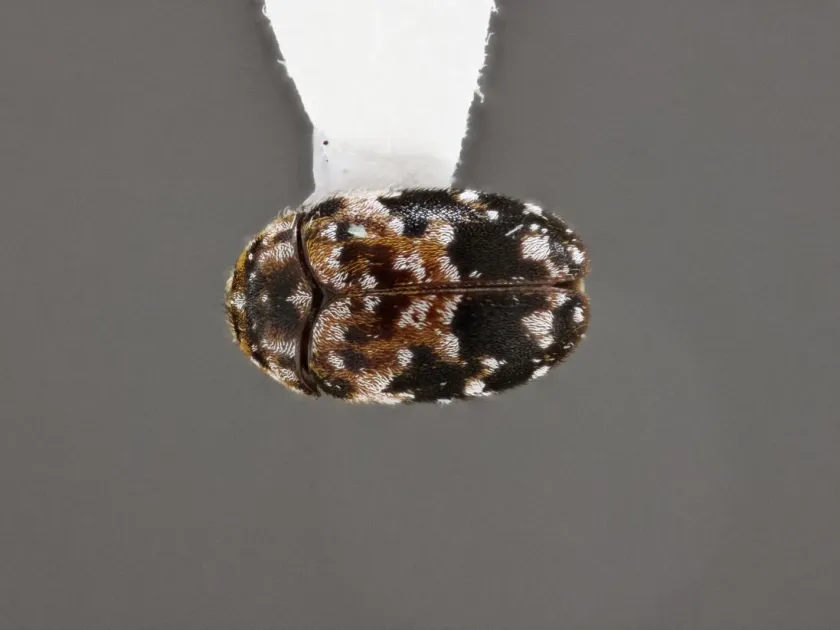
Trogoderma anthrenoides belongs to the family Dermestidae within the order Coleoptera. Adult beetles are small, typically ranging from 2 to 4 mm in length, and possess an oval body shape covered with fine hairs.
The coloration of the insect varies from dark brown to black, often featuring a distinct pattern of light-colored scales on the elytra. The larvae of this species develop covertly, possessing a spindle-shaped body and dense hair, which aids in their defense against predators.
The life cycle consists of four stages: egg, larva, pupa, and adult. Adults are short-lived and primarily focused on mating, while the larval stage causes the most significant damage due to their strong mouthparts.
A notable feature of this species is its high adaptability to low moisture content in the substrate. Larvae can survive starvation for long periods, making complete eradication in warehouse environments challenging.
Females deposit eggs directly into the food substrate or into cracks in packaging, ensuring immediate access to food sources for the newly hatched larvae.
What it damages
This pest is a typical inhabitant of grain storages and warehouses, attacking products of both plant and animal origin. The primary damage is inflicted on cereal crops such as wheat, corn, rice, and barley.
In addition to grain, Trogoderma anthrenoides can infest seeds of legumes, dried fruits, nuts, and processed products, including flour and animal feeds.
Under storage conditions, the pest is also capable of destroying collections of natural fibers, leather, and other materials of animal origin, making it a threat to a wide range of goods.
Larvae consume the interior of the grain, leaving behind only empty shells filled with frass and cast larval skins. This results in significant loss of mass and reduction in the commercial quality of the products.
Infested grain becomes unsuitable for food purposes and sowing, as the larvae destroy the germ, significantly lowering seed germination energy to critical levels.
Signs of infestation
The main sign of infestation is the presence of large amounts of "dust" and shell fragments within the grain mass, which are formed as a result of larval feeding activity.
During inspection of products, one can find shed larval skins (exuviae), which accumulate in the corners of containers, floor cracks, or near areas where infested material is stored.
In areas of heavy infestation, a specific musty odor is observed, emanating from the deteriorated grain mass. The grain itself becomes rough to the touch and loses its natural shiny surface.
Another sign of the pest's presence is the occurrence of adults on warehouse surfaces, especially near light sources in the evening or on windowsills.
When using sieves to clean grain, live larvae can be detected; they are typically active and attempt to hide from direct light by burrowing deeper into the sample.
Control measures
The foundation of control is strict adherence to warehouse sanitation, including regular wet cleaning and the removal of all residues of old grain.
An effective method includes freezing warehouses during the winter period or, conversely, heating grain to temperatures lethal to all developmental stages of the insect.
Fumigation of grain in airtight silos using approved phosphine-based products allows for high efficacy against hidden forms of infestation.
For population monitoring, it is recommended to use pheromone traps, which help to detect the onset of infestation in a timely manner and localize the focus before it spreads.
- Regular clearing of the area around warehouses.
- Use of airtight packaging for storing valuable batches.
- Monitoring grain moisture (dry storage reduces reproductive rates).
Taxonomy
- Latin name
- Trogoderma anthrenoides
- Order
- Coleoptera (beetles)
- Family
- Dermestidae
- EPPO code
- TROGAT
Discussion
No discussions yet — be the first.