
Narrow cabinet beetle
Trogoderma angustum
Description
How to identify
The narrow cabinet beetle (Trogoderma angustum) is a member of the Dermestidae family within the order Coleoptera. It is a well-known pest that thrives in indoor storage environments.
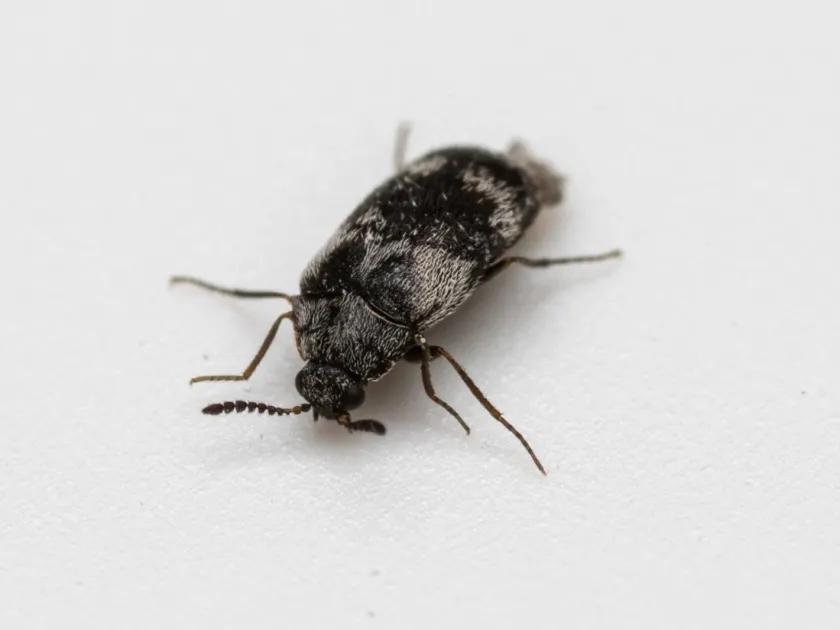
Adult beetles are small, typically measuring between 2.5 to 3.5 mm in length. Their bodies are elongated, ranging in color from dark brown to black, and are covered with fine setae.
The larvae are particularly active and are easily identified by their dense, long hair. They are brownish and move through stored products, feeding as they go.
The life cycle involves complete metamorphosis: egg, larva, pupa, and adult. In favorable indoor temperatures, the beetle can complete its development in several months.
This species is highly adaptable to the conditions inside warehouses, food processing facilities, and homes, making it a persistent challenge for facility managers.
What it damages
This beetle is a generalist feeder, causing significant damage to various dried plant and animal products. It is a major pest for grain storage and dried food supplies.
Beyond grains and cereals, the larvae can damage keratin-based materials, including wool, fur, leather, and even insect collections preserved in museums.
In stored grain, the larvae consume the interior of the kernels, often leaving only the outer shell. This results in direct loss of weight and quality of the stored produce.
Infested products become contaminated with larval skins, frass (excrement), and body parts, making the material unsuitable for human or animal consumption.
If left unmanaged, the population can grow rapidly, leading to substantial economic loss and the total degradation of entire stockpiles of raw materials.
Signs of infestation
The presence of cast larval skins (exuviae) in storage areas, corners, or floor cracks is the most reliable sign of an ongoing infestation.
Direct inspection of stored grain often reveals small holes or damage on the seeds, accompanied by fine dust created by the feeding activity of the larvae.
Adult beetles may be spotted resting on walls or near light sources, especially during their peak activity periods in the spring and summer months.
Signs of damage to packaging materials, such as holes or weakened fabric in sacks, may indicate that the infestation is spreading to new batches of products.
Pheromone traps are highly recommended for early detection of the beetles, allowing for targeted intervention before the infestation becomes widespread.
Control measures
Sanitation is the cornerstone of control. Regularly cleaning up spilled grain, debris, and dust eliminates the food sources required for larval development.
Professional fumigation of warehouses is often necessary to eliminate deep-seated infestations in structural components and hard-to-reach areas of equipment.
Temperature management plays a vital role; keeping storage areas cool and dry significantly inhibits the growth and reproductive capacity of the beetles.
It is essential to inspect all incoming stock for signs of infestation to prevent the introduction of the pest into the storage facility from outside sources.
Using authorized insecticides for residual spraying of storage surfaces can provide a protective barrier against future re-infestation of the stored goods.
Taxonomy
- Latin name
- Trogoderma angustum
- Order
- Coleoptera (beetles)
- Family
- Dermestidae
- EPPO code
- TROGAN
Discussion
No discussions yet — be the first.