
Black larder beetle
Dermestes haemorrhoidalis
Description
How to identify
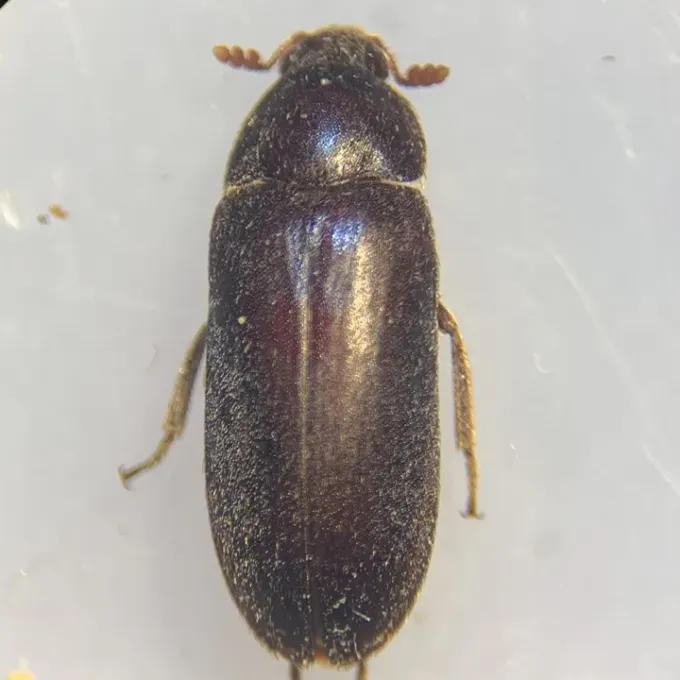
The black larder beetle (Dermestes haemorrhoidalis) belongs to the family Dermestidae within the order Coleoptera. Adult beetles typically measure between 7 and 10 mm in length and feature an elongated body with a deep black or dark brown glossy appearance.
The larvae are covered in dense, short hairs and are highly mobile. They possess a robust, chewing mouthpart structure specifically adapted for consuming tough organic materials, including dried animal tissues.
A diagnostic feature for identifying the adult stage is the presence of reddish-brown hairs on the ventral side of the body, which helps experts distinguish it from other related Dermestes species.
These beetles are capable of flight, which facilitates their rapid spread throughout storage facilities and the infestation of new commodities stored in warehouses or food processing plants.
The life cycle follows a complete metamorphosis, including egg, larval, pupal, and adult stages. Under favorable conditions, the development from egg to adult can be completed in a few weeks.
What it damages
While the black larder beetle primarily feeds on animal-based products, it is a significant pest of stored grain and seed, especially when commodities have high moisture or organic debris.
Infestations are common in warehouses, grain elevators, and food manufacturing units, where they feed on dried meat, fish, skins, furs, and animal-derived components found in certain feeds.
High population densities lead to physical damage as the beetles and their larvae bore into packaging, including cardboard boxes, sacks, and other storage containers, compromising product integrity.
The larval stage is the most destructive, as they burrow deep into the substrate, creating tunnels that render the stored goods unsuitable for retail or consumption.
In agricultural settings, they are less likely to be found in open fields, preferring anthropogenic structures where food resources are accumulated to provide a stable environment for their offspring.
When it appears
As a synanthropic species, the black larder beetle is highly dependent on the microclimate maintained within warehouses and human dwellings rather than external environmental conditions.
In temperature-controlled storage facilities, the beetle remains active throughout the year, as the stable environment allows for continuous breeding cycles without winter diapause.
Biological activity usually peaks during warmer months, as higher ambient temperatures accelerate the metabolic processes, leading to faster larval growth and pupation.
Even when temperatures drop, adults can successfully overwinter in cracks, crevices, behind skirting boards, or in other secluded locations where they are protected from extreme cold.
Migration into storage areas often intensifies during spring, when warming conditions trigger increased movement in search of new sites for oviposition and larval development.
Signs of infestation
The most common sign of an infestation is the presence of adult beetles near windows, lights, or on surfaces, as they are often attracted to light sources during the night.
Inspection often reveals damage to packaging and the presence of exuviae—the shed larval skins that appear as translucent, ghostly shells left behind after each molt.
Accumulations of larval excrement, which resemble a fine dark dust, often accumulate beneath or inside infested products, signaling active feeding and damage.
The commodities themselves may show clear signs of burrowing, with riddled surfaces or internal tunneling that significantly reduces both the quality and volume of the stored goods.
- Sightings of adult beetles in storage or production zones.
- Presence of shed larval skins (exuviae) near commodities.
- Specific unpleasant odors resulting from high-density infestations.
- Holes or perforations in packaging and storage materials.
- Fine dark dust indicative of larval excrement near feeding sites.
Control measures
Effective management of the black larder beetle starts with strict warehouse sanitation, including regular cleaning to remove dust, debris, and spilled commodities.
Preventative measures include sealing all structural gaps in the warehouse, installing fine-mesh screens on ventilation ports, and conducting rigorous inspections of incoming stock.
For established infestations, the use of contact insecticides registered for food-handling areas can be effective, provided that application follows strict safety guidelines.
Fumigation or heat treatment is recommended for infested batches to eliminate the pest at all life stages before the products are allowed for distribution.
Monitoring using pheromone-based or light traps is a crucial strategy for detecting early infestations, allowing for rapid intervention before the population reaches critical levels.
Taxonomy
- Latin name
- Dermestes haemorrhoidalis
- Order
- Coleoptera (beetles)
- Family
- Dermestidae
- EPPO code
- DERMHA
Discussion
No discussions yet — be the first.