
Black larder beetle
Dermestes ater
Description
How to identify
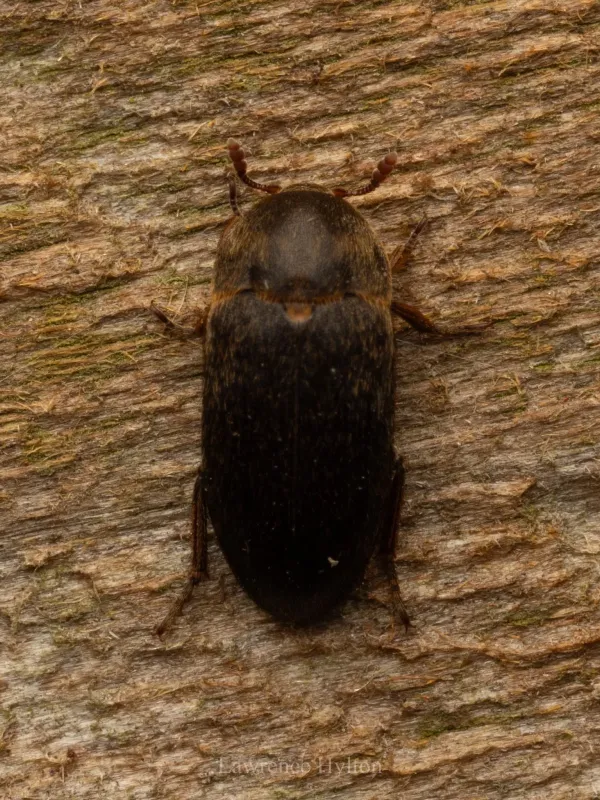
The black larder beetle (Dermestes ater) belongs to the order Coleoptera and the family Dermestidae. Adult beetles typically measure between 6 and 9 mm in length and possess a characteristic oval, convex body shape.
The color of the beetle is deep black, often with a subtle glossy sheen. The surface is sparsely covered with dark, fine hairs. The head is relatively small and retracted into the prothorax, and the antennae are clearly clubbed.
The larvae, which are responsible for most of the damage, grow up to 15 mm in length. They are covered in long, dense, brown bristles and possess two sclerotized projections on the final abdominal segment, known as urogomphi.
The lifecycle consists of egg, larva, pupa, and adult stages. Under optimal temperatures of 25–30°C, the lifecycle is rapid, allowing the beetle to complete several generations within a single calendar year.
These insects are highly adaptable and thrive in indoor environments such as granaries, warehouses, and food processing facilities, where they find stable temperatures and abundant food sources.
What it damages
Dermestes ater is a significant pest of stored products, primarily those of animal origin. It poses a serious threat to warehouses storing dried fish, meat, leather, wool, silk, and dairy products.
The larvae possess strong mandibles capable of boring through various materials. They feed voraciously on high-protein substances, causing significant weight loss in stored goods and rendering them unfit for sale or consumption.
In addition to food, the larvae can damage structural elements of buildings if they contain organic components, such as wooden structures infested with other pests or organic insulation materials.
Grain products and livestock feed are also susceptible, particularly those containing bone meal or meat-based additives. Their activity leads to contamination of the entire batch with shed skins and frass.
Economic damage is twofold: direct loss of commodity volume and qualitative devaluation due to the presence of live insects, larvae, and physical degradation of the products.
Signs of infestation
The most immediate sign of an infestation is the visual detection of adult beetles. They are often found in dark, undisturbed corners, near baseboards, or under storage pallets.
The presence of shed larval skins (exuviae) is a primary indicator of population growth. Since larvae molt several times during their development, accumulations of these skins are clear signs of breeding sites.
Infested food items often display irregular holes or tunnels. In dry products, you may notice a fine, dusty residue composed of larval excrement and pulverized food particles.
A foul, musty odor in the storage facility often indicates an infestation. This is frequently caused by the accumulation of decaying organic matter and the metabolic waste produced by a large population of larvae.
Damage to packaging, especially paper or cardboard bags, usually appears as small, jagged holes where larvae have chewed their way into the product.
Control measures
Sanitation is the cornerstone of control. Regularly vacuuming and cleaning floors, wall gaps, and storage areas removes food crumbs and hiding places, which discourages the establishment of a population.
Chemical control involving approved insecticides may be necessary in severe cases. However, all treatments must be applied in accordance with local regulations to ensure food safety.
- Seal all structural cracks and crevices where beetles might hide.
- Monitor storage areas using pheromone-baited or sticky traps.
- Maintain lower storage temperatures (below 15°C) to inhibit beetle metabolic activity.
- Perform rigorous inspection of incoming raw materials to prevent the introduction of the pest.
Preventative measures are essential. Storing high-risk products in heavy-duty, pest-proof containers effectively eliminates the access point for adult beetles and migrating larvae.
Taxonomy
- Latin name
- Dermestes ater
- Order
- Coleoptera (beetles)
- Family
- Dermestidae
- EPPO code
- DERMAT
Discussion
No discussions yet — be the first.