
Woodroff's carpet beetle
Attagenus woodroffei
Description
How to identify
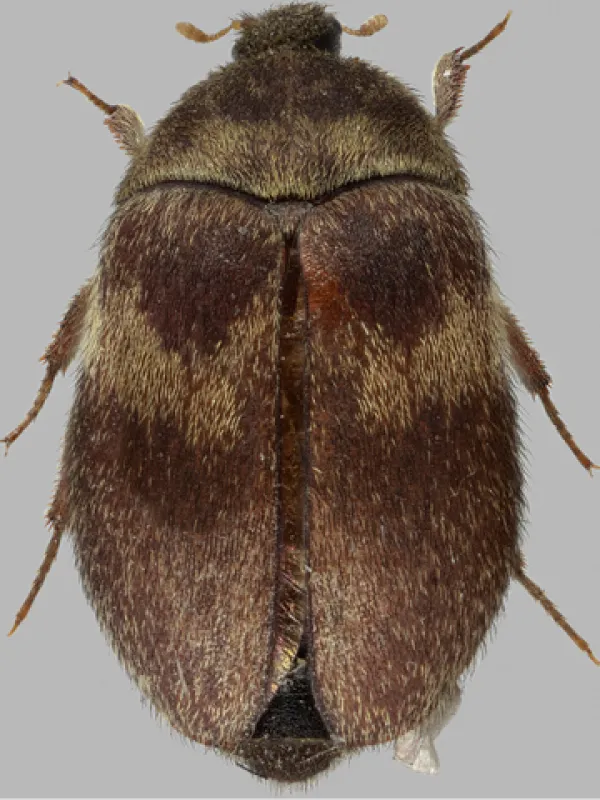
Attagenus woodroffei, commonly known as Woodroff's carpet beetle, belongs to the Dermestidae family. Adult beetles are small, typically 3–5 mm in length, with an oval-shaped body covered in fine hairs, ranging in color from dark brown to black.
The larvae of this species are distinct, featuring a hairy, elongated body often described as having a tuft of longer bristles at the posterior end, which aids in their identification under magnification.
These insects are highly adaptable to indoor environments, which is why they are often encountered in homes, warehouses, and museums where organic materials are stored and kept for long periods.
The lifecycle follows complete metamorphosis: egg, larva, pupa, and adult. The larval stage is the longest and most destructive, as they consume various protein-rich materials to fuel their growth and subsequent pupation.
Proper identification usually requires consulting a specialist or using a microscope, as the external morphology of Attagenus species is quite similar and can easily be confused with other common carpet beetles.
What it damages
Woodroff's carpet beetles are known to feed on a variety of materials of both animal and plant origin. Their primary diet includes keratin-based items like wool, fur, leather, and natural fiber textiles.
In addition to textiles, these larvae can cause damage to stored plant products, including dried seeds, grains, and even plant-based collections, making them a nuisance in agricultural storage and research facilities.
The pests often infiltrate packaging, creating tunnels through the materials they consume. This behavior ruins the structural integrity of goods and leads to significant financial losses for manufacturers and warehouse managers.
Damage is characterized by irregular holes and surface grazing. Beyond direct consumption, the contamination caused by larval excrement and cast-off skins makes the remaining, unaffected goods unusable.
In archives and libraries, these beetles can damage historical artifacts and book bindings that use hide glue or parchment, presenting a persistent risk to the preservation of cultural items.
When it appears
In climate-controlled or heated buildings, Woodroff's carpet beetles can remain active and reproduce throughout the entire year, as they do not require a strictly seasonal cycle for their development.
Adult beetle activity is typically higher during the warmer months, specifically from late spring through summer, when they are more prone to flying and dispersing to new locations within a facility.
While the larvae may experience slowed metabolic rates in colder conditions, they exhibit significant resilience and can survive in unheated warehouses or areas where temperatures fluctuate, resuming activity as soon as conditions improve.
Monitoring for signs of activity is recommended in spring, as this is when the new generation of adults begins to emerge and search for mating opportunities and new food sources for their offspring.
Recognizing the year-round potential for infestation is crucial for effective management, as one may wrongly assume that winter provides a natural break from the pest pressure.
Signs of infestation
The most reliable sign of an infestation is the presence of cast-off larval skins. These empty shells are often found in secluded areas like baseboards, under carpets, or near stored goods.
Accumulations of fine, powdery dust under items represent larval excrement. Finding this debris is a strong indicator that an active colony of carpet beetles is feeding on the material above or nearby.
Adult beetles seen crawling on walls, windowsills, or near artificial light sources are an obvious sign of a large population density within the structure, indicating that they have reached a reproductive stage.
Surface damage on fabrics or leather, characterized by irregular grazing or holes with associated debris, is a signature of larval activity in textile or inventory storage areas.
A musty or unpleasant odor emanating from stored boxes or furniture can be a secondary indicator that a population of larvae is thriving and degrading organic materials inside.
Control measures
Strict sanitation is the foundation of carpet beetle control. Regularly cleaning cracks, crevices, and storage areas removes the organic debris that serves as food for larvae.
Chemical control using authorized contact insecticides can be effective when applied to infested areas. It is essential to choose products that are safe for use in storage environments and to follow label directions.
Non-chemical methods, such as freezing infested items for several days or applying targeted heat treatments, are excellent ways to eliminate infestations without risking chemical exposure to sensitive inventory.
Pheromone traps are highly effective for monitoring adult beetle populations and pinpointing the location of an infestation, allowing for a proactive rather than reactive approach to control.
- Inspect all incoming shipments for signs of insect activity.
- Store vulnerable items in tightly sealed, pest-proof containers.
- Keep storage areas dry and free of excessive dust and animal hair.
- Promptly isolate and treat or discard infested materials.
Taxonomy
- Latin name
- Attagenus woodroffei
- Order
- Coleoptera (beetles)
- Family
- Dermestidae
- EPPO code
- ATTGWO
Discussion
No discussions yet — be the first.