
Varied carpet beetle
Anthrenus verbasci
Description
How to identify
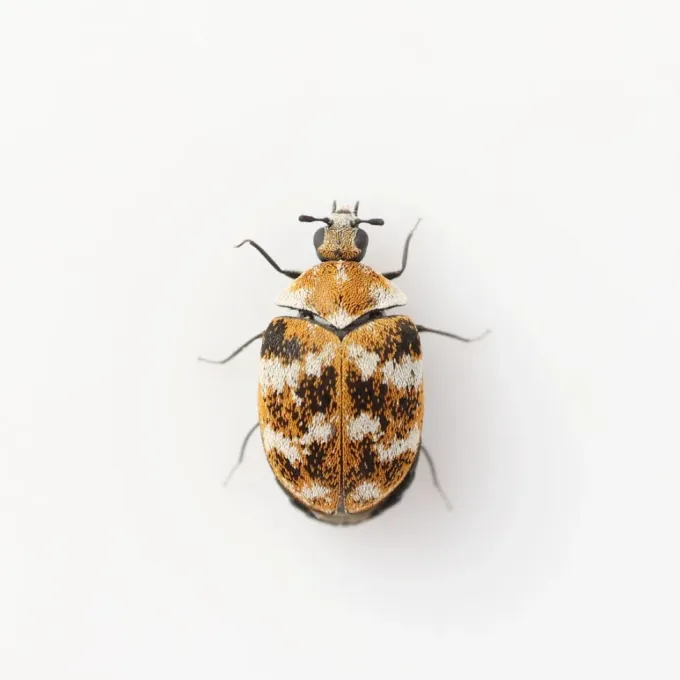
The varied carpet beetle is a small insect, typically measuring 2.5 to 3.5 mm in length. Its body is broadly oval and covered in a complex pattern of white, brown, and yellow scales.
The larvae are approximately 4-5 mm long, densely covered in stiff brown bristles, and have distinct tufts of hair at the rear end, which act as a defense mechanism and a key diagnostic feature.
Adult beetles are often found on flowering plants during the summer months, where they feed on pollen and nectar. They gain access to buildings through windows, vents, or infested materials.
The developmental cycle is highly variable, depending on food quality and ambient temperature, often spanning from several months to three years to complete one generation.
Females lay eggs in dark, protected areas such as cracks, crevices, or accumulated lint, ensuring the newly hatched larvae have immediate access to a food source.
What it damages
The larvae cause significant damage by consuming organic matter containing keratin and dried plant proteins, including herbarium specimens, stored seeds, and biological collections.
They are capable of hollowing out seeds and skeletonizing dried leaves, often leaving only the veins and the outer epidermis, rendering the specimens useless for scientific study.
In museum and library settings, these pests can cause irreversible harm to collections of historical significance, turning valuable research material into dust and waste.
Infestations are often detected late because the larvae prefer to work within the inner layers of the substrate, hidden from light and inspection.
Beyond plants, they can also damage wool, silk, fur, and leather items frequently found in storage facilities, complicating pest management strategies.
When it appears
Adult beetles are most active in late spring and early summer, which is when they leave their feeding sites to search for mates and new egg-laying locations.
In temperature-controlled environments like museums or archives, breeding can continue throughout the year, as the insects do not rely on seasonal climate changes.
The highest level of larval damage typically occurs during the autumn and winter seasons, as larvae feed actively before entering the pupal stage.
Migration from outdoor environments into storage areas usually peaks in June and July, making this the critical window for inspection and preventative measures.
The long developmental period means that a single infestation can persist for years if the pest is not completely eradicated during the initial discovery.
Signs of infestation
The primary indicators of an infestation are small, irregular holes in plant specimens and the presence of fine, dark granular frass (excrement) around the damage.
The discovery of cast-off larval skins (exuviae) is a clear sign that a population is thriving and growing within the storage environment.
- Evidence of grazing on dried plant leaves.
- Empty seed coats or partially consumed seeds.
- Accumulation of fine dust on shelves and inside storage cabinets.
- Signs of boring into dense organic materials.
Inspecting herbarium sheets by gently tapping them over a white surface can reveal hiding larvae that might otherwise go unnoticed.
Dark patches around the base of stems or leaves may indicate a combination of larval feeding and secondary fungal growth due to moisture introduced by the pest.
Control measures
Strict housekeeping is the foundation of control, which involves the regular use of HEPA-filter vacuums to eliminate dust and organic debris that attract the beetles.
Freezing infested materials at temperatures below -18°C for at least 72 hours is a non-toxic and highly effective method for killing all life stages of the beetle.
Pheromone-baited sticky traps should be placed strategically to monitor adult activity and identify the source of the infestation early in the process.
Storage in airtight containers or specialized museum cabinets provides a physical barrier, effectively preventing the beetles from reaching and damaging the collections.
Chemical treatments should be used as a last resort, focusing on perimeter spraying and ensuring no direct contact between insecticides and valuable historical biological specimens.
Taxonomy
- Latin name
- Anthrenus verbasci
- Order
- Coleoptera (beetles)
- Family
- Dermestidae
- EPPO code
- ANTRNE
Discussion
No discussions yet — be the first.