
Anthrenus pimpinellae
Anthrenus pimpinellae
Description
How to identify
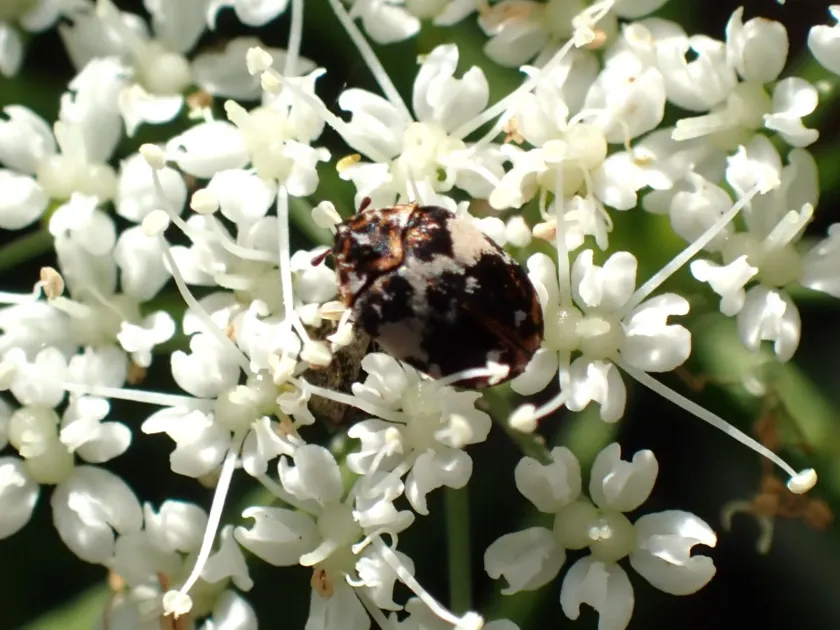
Anthrenus pimpinellae is a species of beetle belonging to the family Dermestidae. Adult beetles are small, typically measuring 2.5 to 3.5 mm in length, with an oval-shaped body covered in intricate scales that form a characteristic mottled pattern of white, black, and yellow.
The larvae, often referred to as carpet beetle larvae, are elongated and densely covered with brownish hairs, featuring distinctive tufts of bristles at the posterior end. They are typically found in dark, undisturbed areas where organic matter accumulates.
The life cycle involves complete metamorphosis: egg, larva, pupa, and adult. In indoor environments with stable temperatures, the life cycle can be completed within a few months, allowing for overlapping generations throughout the year.
Adults are commonly found outdoors on flowering plants, feeding on nectar and pollen, while the larval stage is strictly associated with dry organic material, which serves as their primary food source.
The species is well-adapted to surviving in diverse human-made environments, including grain stores, museums, and residential homes, where they find protected conditions for development.
What it damages
This beetle is a significant pest of stored products, particularly in agricultural settings where it targets seeds, grains, and dried plant materials. Larvae are the primary destructive stage, feeding on the germ portion of seeds.
The infestation can cause severe damage to valuable seed stocks, rendering them inviable for planting. They consume the internal tissues, leaving behind empty husks and fine frass that contaminates the entire product.
Beyond agricultural seeds, the larvae can destroy herbarium specimens, stored dry fruits, and processed plant derivatives. In museum settings, they are infamous for attacking natural history collections.
While adult beetles generally do not damage crops in the field, their presence as pollinators means they can occasionally be associated with fungal spores, potentially aiding the dispersal of plant pathogens.
The hidden nature of the larval feeding means that damage is often not discovered until it has become widespread, significantly impacting the quality and quantity of stored goods.
Signs of infestation
One of the most obvious signs of infestation is the presence of small, clean-cut holes in the surface of stored seeds or dried materials. Accumulation of powdery debris or larval excrement nearby is a definitive indicator.
The presence of cast-off larval skins (exuviae) is a clear sign that a population is actively growing. These skins are often found in dark corners, crevices of storage containers, or beneath the stored product itself.
Finding adult beetles, particularly on window sills or near light sources in spring and early summer, suggests a breeding population exists within the premises and requires immediate inspection.
In cases of heavy infestation, a distinct musty or foul odor may be detectable. This odor is usually caused by the combination of accumulated larval frass, decaying organic matter, and potential secondary mold growth.
Damaged herbarium sheets or dried plant samples often show irregular tunneling and surface erosion, which are characteristic of larval grazing behavior under the protection of the material.
Control measures
Sanitation is the cornerstone of control. Regularly cleaning storage areas to remove dust, spilled grain, and other organic debris is critical to eliminating the larval food supply and nesting sites.
Storing seeds and dry goods in airtight, pest-proof containers is the most effective preventative measure. It is essential to inspect stored items regularly for any signs of larval activity or adult presence.
Temperature manipulation is highly effective. Exposing infested materials to extreme cold (freezing) or heat (above 50°C) is a standard non-chemical approach to eliminate all stages of the beetle.
If an infestation becomes severe, structural fumigation or the application of approved residual insecticides within the storage facility may be necessary to eradicate the pest completely.
- Seal cracks and crevices in floors and walls
- Use pheromone-baited traps for population monitoring
- Implement strict inventory rotation (First-In, First-Out)
- Ensure adequate ventilation to keep humidity levels low
Taxonomy
- Latin name
- Anthrenus pimpinellae
- Order
- Coleoptera (beetles)
- Family
- Dermestidae
- EPPO code
- ANTRPI
Discussion
No discussions yet — be the first.