
Oceanian carpet beetle
Anthrenus oceanicus
Description
How to identify
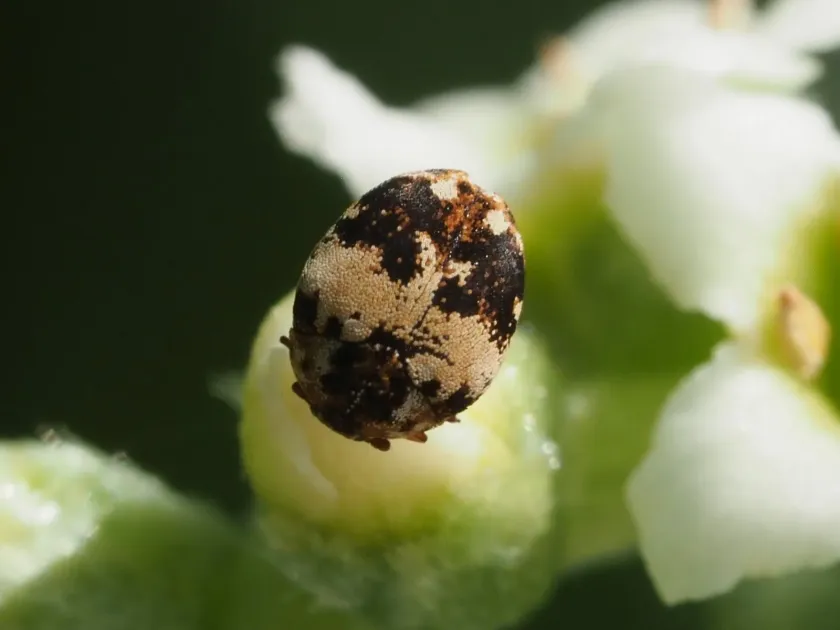
The Oceanian carpet beetle (Anthrenus oceanicus) is a member of the family Dermestidae. These small beetles are typically 2–3 mm long and exhibit a rounded, convex body shape covered with patterned scales in shades of white, brown, and yellow.
The larvae are particularly distinct, featuring an elongated body covered in dense setae (hairs). These hairs often form tufts at the end of the abdomen, serving as a defensive mechanism and aiding in movement through the substrate they infest.
As holometabolous insects, their lifecycle consists of egg, larva, pupa, and adult stages. Under optimal warehouse conditions, particularly with adequate food and warmth, they can maintain continuous generations, leading to persistent infestations.
Adult beetles are often elusive, though they are frequently observed near light sources, such as windows, due to their positive phototactic behavior. Detecting them requires diligence and the use of specialized monitoring tools.
Professionals utilize pheromone-based sticky traps to detect the presence of Anthrenus oceanicus within storage facilities, which helps identify the extent of an infestation before it reaches critical levels.
What it damages
This beetle is a significant polyphagous pest of stored products. It primarily attacks dried plant materials, including cereals, flour, pulses, oilseeds, and dried fruits, effectively consuming both the germ and endosperm of the grains.
Beyond plant-based products, the larvae can consume animal-derived commodities, such as bone meal, dried fish, wool, and natural fabrics. This broad diet makes them a versatile threat in logistics and warehousing.
Larval feeding destroys the structural integrity of seeds, rendering them useless for germination. Infested stocks are contaminated with frass (excrement) and cast-off larval skins, which makes the product unacceptable for consumer use.
The feeding activity often increases the moisture content of the stored mass, creating localized conditions suitable for mold and fungus growth, which further accelerates the spoilage of the remaining commodity.
In large storage environments, the Oceanian carpet beetle spreads rapidly through packing materials, equipment, and structural gaps, necessitating integrated pest management strategies to secure large volumes of stored goods.
When it appears
In climate-controlled storage facilities, the Oceanian carpet beetle can remain active throughout the year. The ideal developmental temperature ranges from +22°C to +28°C, which allows for consistent population growth.
During the spring and summer months, adult beetles become more mobile and begin to disperse, seeking protein-rich substrates for egg-laying. This period represents the highest risk for new infestations in clean product batches.
The duration of the lifecycle is highly temperature-dependent. At warmer temperatures, the transition from egg to adult may take only two to three months, while cooler temperatures can significantly extend this developmental window.
In colder environments or seasons, the larvae may enter a state of diapause, slowing their metabolic activity to survive. This adaptation allows them to persist in dormant conditions within warehouse cracks or hidden residues.
Ongoing monitoring is essential regardless of the season, but special focus should be placed on facility transitions and arrival of new stock, as dormant populations can become active as soon as environmental conditions improve.
Signs of infestation
The primary indicators of infestation include tiny, pin-prick-sized holes in packaging. Upon opening, one might notice fine, powdery debris mixed with damaged grain particles, signaling larval feeding activity.
The presence of cast-off larval exuviae (molted skins) on the floor or near stored bags is a clear sign that a breeding population has been established in the vicinity for a considerable period.
A distinctive musty odor often permeates an infested area, which is usually a result of secondary fungal development triggered by the high moisture levels created by the larvae feeding on the grain stock.
Visual inspection of window sills and light sources may reveal clusters of adult beetles. If live or dead beetles are found here, it is a definitive call to action to inspect the surrounding inventory for the primary breeding site.
Sifting grain samples through fine-mesh sieves often reveals the larvae themselves, which appear as hairy, mobile organisms, alongside their dark, granular excrement pellets, providing immediate confirmation of the pest presence.
Control measures
Strict sanitation is the foundation of management. Regularly vacuuming warehouses to remove all grain dust, spillages, and organic debris from cracks and floor joints is significantly more effective than standard sweeping methods.
Maintaining storage temperatures below +10°C effectively suppresses beetle development. This temperature control is the most sustainable and non-chemical method for protecting seeds and food commodities from infestation.
For established infestations, professional fumigation using phosphine-based products is the standard approach to eliminate all life stages, including larvae embedded deep within the product bulk.
Strategic use of pheromone-baited traps allows for early detection, enabling facility managers to apply targeted surface treatments instead of resorting to massive, full-scale fumigation efforts.
Storing high-value products in hermetically sealed packaging, such as thick-walled polymer bags or high-grade paper containers, creates a physical barrier that prevents adult beetles from accessing the food source.
Taxonomy
- Latin name
- Anthrenus oceanicus
- Order
- Coleoptera (beetles)
- Family
- Dermestidae
- EPPO code
- ANTRFA
Discussion
No discussions yet — be the first.