
Brown carpet beetle
Anthrenus fuscus
Description
How to identify
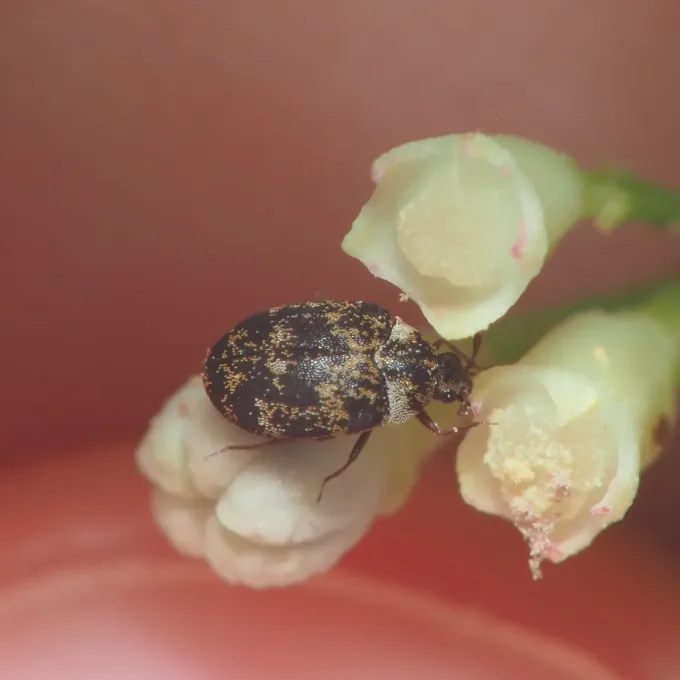
The brown carpet beetle, known scientifically as Anthrenus fuscus, is a member of the family Dermestidae within the order Coleoptera. Adult beetles are small, oval-shaped, and measure between 2.5 and 3.5 mm in length.
Their bodies are typically dark brown or black, covered in dense hairs that may form faint patterns of lighter scales. A key diagnostic feature for the genus Anthrenus is the presence of clubbed antennae.
The larvae, which are the primary destructive stage, have a spindle-shaped body densely covered with tufts of bristles, giving them a distinct "hairy" appearance. Larval color ranges from pale yellow to dark brown.
The life cycle undergoes complete metamorphosis, including egg, larva, pupa, and adult stages. This beetle is highly adapted to indoor environments, often residing in dark, undisturbed areas.
These insects are elusive, as they prefer to hide in cracks, crevices, and accumulations of organic debris, making early detection challenging in agricultural storage facilities.
What it damages
Anthrenus fuscus is a significant stored-product pest that feeds on a wide range of organic materials. In agricultural settings, it primarily infests stored grain, flour, feed, and bran.
Larvae feed internally on grain kernels, hollowing them out and leaving behind frass and fine dust. This causes severe weight loss in stored stock and reduces germination potential for seeds.
Beyond plant-based products, these beetles readily infest animal-derived materials, such as wool, fur, leather, and insect collections, posing a risk to both warehouses and archival storage.
Infestations often originate in neglected areas of a warehouse where grain dust, spilled feed, and lint accumulate, providing a stable food supply for multiple generations of larvae.
The presence of larvae leads to contamination of the entire product batch with excrement and shed larval skins, rendering the goods unmarketable due to aesthetic and health concerns.
When it appears
In temperature-controlled storage facilities, the brown carpet beetle can breed throughout the year. The optimal temperature range for their development is between 20°C and 25°C.
Adult beetles exhibit increased activity during the spring and summer months, as they emerge to mate and disperse to new food sources, often flying towards light sources.
During colder periods, the species usually persists in the larval stage. Larvae are capable of entering a state of diapause under unfavorable conditions, which enhances their survival rates.
The duration of the developmental cycle is highly dependent on food availability and temperature; an abundance of high-quality food significantly accelerates the rate of population growth.
Frequent monitoring near windows, vents, and lighting fixtures during warmer weather is a critical strategy for detecting early signs of adult emergence and potential infestation.
Signs of infestation
The most common sign of an infestation is the presence of small, irregular exit holes in grain kernels, accompanied by fine, floury dust (frass) under storage containers.
Spotting adult beetles on warehouse floors, near baseboards, or on windowsills indicates an active population that has likely established itself within the facility.
The discovery of discarded larval skins (exuviae) intertwined with grain fragments or webbing is a definitive indication of a reproducing population in the immediate vicinity.
A persistent, musty odor in a storage area is often a symptom of advanced infestation, suggesting that larvae have been feeding and multiplying over an extended period.
Using sticky traps and pheromone-based monitors is recommended to track beetle movement and pinpoint the location of the source infestation within a complex facility.
Control measures
Sanitation is the cornerstone of control. Regularly cleaning warehouse floors, removing spilled grain, and eliminating dust buildup effectively denies the pests their breeding grounds.
Fumigation of empty storage units before loading new grain is a highly effective preventative measure to ensure that overwintering larvae are completely eradicated.
Storing commodities in airtight, pest-proof containers prevents adult beetles from accessing the grain and laying eggs, significantly reducing the likelihood of infestation.
If an infestation is confirmed, targeted application of residual insecticides approved for grain storage facilities is necessary to treat structural crevices and hiding spots.
- Regular inspection of incoming stock for signs of pests.
- Maintaining relative humidity below 14% in storage areas.
- Safe disposal of heavily infested materials to prevent cross-contamination.
Taxonomy
- Latin name
- Anthrenus fuscus
- Order
- Coleoptera (beetles)
- Family
- Dermestidae
- EPPO code
- ANTRFU
Discussion
No discussions yet — be the first.