
Carpet beetle
Anthrenus
Description
How to identify
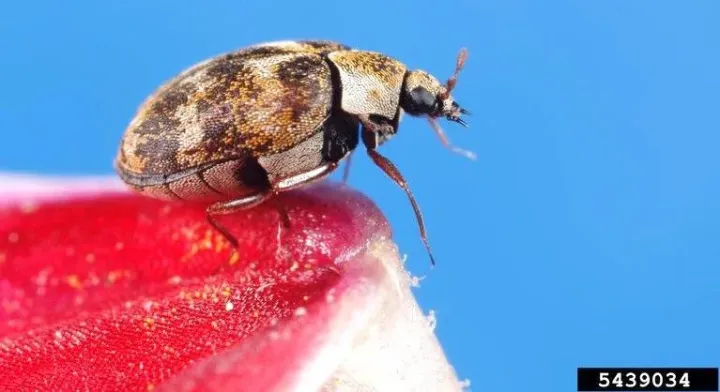
The carpet beetle (lat. Anthrenus) is a genus of beetles belonging to the family Dermestidae. Adult beetles are small, usually 2 to 4 mm in length, with an oval or rounded body shape.
Their appearance is often characterized by a mottled pattern of tiny scales on their wing covers, which can range in color from white to yellow or dark brown.
The larvae are typically small, hairy, and have a cigar-shaped body covered with dense bristles, which gives them a distinctive appearance often called "woolly bears".
The mouthparts of the larvae are specialized for chewing tough materials, allowing them to feed on complex proteins, including keratin and animal fibers.
While adults are often found outdoors on flowers feeding on pollen, the larvae are photophobic and prefer to dwell in dark, undisturbed areas.
What it damages
Larval stages are responsible for the damage, as they are capable of consuming a wide variety of dry products containing organic matter.
In agricultural settings, they infest grain stores, seed collections, and dried agricultural goods by feeding on particles of debris and protein-rich dust.
They are particularly problematic in warehouses where they exploit gaps in flooring and walls to consume accumulated grain dust and feed residues.
Beyond food storage, carpet beetles can destroy textiles, leather goods, animal hides, and natural fiber items, making them a threat to mixed-use storage facilities.
Heavy infestations result in structural degradation of products, leading to significant financial losses due to contamination with larval skins and excrement.
When it appears
The life cycle of the carpet beetle is highly flexible and depends heavily on the temperature and humidity levels within the storage environment.
In indoor, climate-controlled environments, breeding can occur throughout the year, leading to overlapping generations and constant pest pressure.
Outdoors, the adults emerge in the spring and summer to feed on nectar, seeking locations to deposit eggs in protected areas.
The duration from egg to adult varies significantly based on environmental conditions, with the larval stage often lasting several months to over a year.
They are known to undergo diapause during adverse conditions, surviving long periods without food until environmental factors become suitable again.
Signs of infestation
A primary sign of infestation is the presence of cast-off larval skins (exuviae), which are left behind in areas where the larvae have been feeding.
Damage is characterized by irregular holes and the presence of fine, powdery debris consisting of waste material and fragments of the consumed product.
The observation of adult beetles near windows or light sources is a strong indicator of a breeding population already established in the vicinity.
A musty odor in storage rooms often signals the accumulation of larval waste products within deep cracks or behind storage shelving.
Monitoring with pheromone or sticky traps is an essential strategy for early detection, helping to identify the presence of beetles before large-scale damage occurs.
Control measures
Strict sanitation is the most effective preventative measure: regularly vacuuming and cleaning floors, shelves, and dark crevices to remove organic buildup.
Storage areas should be sealed to eliminate harborages, using caulk for cracks and ensuring that all containers provide a tight seal against entry.
Physical control methods include extreme temperature treatments, such as freezing or heat treatment, which can kill larvae without the use of chemical pesticides.
Chemical control involving surface insecticides is applicable for professional pest management in empty warehouses before new inventory arrives.
For high-value or infested inventory, professional fumigation remains the industry standard for eradicating carpet beetles in large-scale storage facilities.
Taxonomy
- Latin name
- Anthrenus
- Order
- Coleoptera (beetles)
- Family
- Dermestidae
- EPPO code
- ANTRSP
Discussion
No discussions yet — be the first.