
Mexican bean weevil
Zabrotes subfasciatus
Description
How to identify
The Mexican bean weevil (Zabrotes subfasciatus) is a significant pest of legumes, belonging to the family Bruchidae within the order Coleoptera. Adult beetles are small, usually measuring 2–3 mm in length, with a robust and rounded body shape.
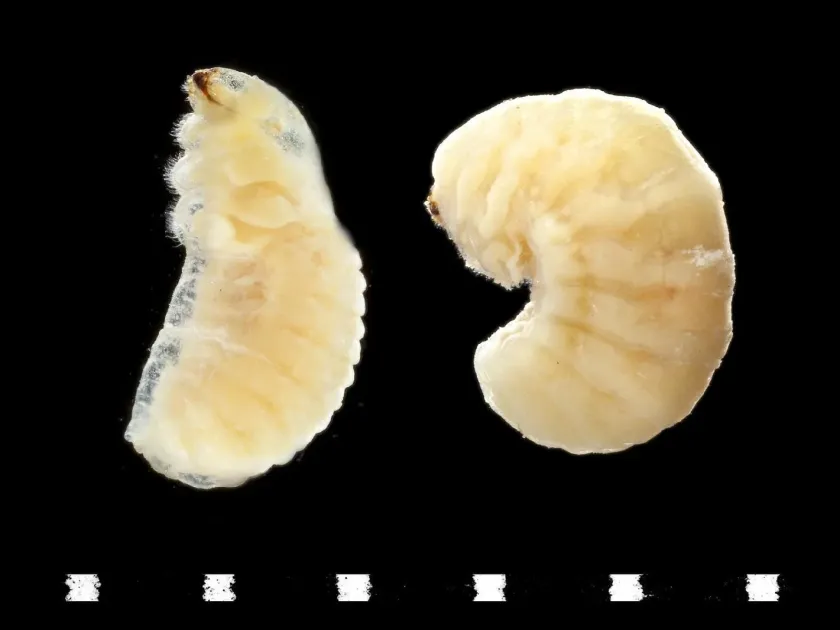
The body is covered with dense hairs, and the coloration ranges from dark brown to black, often with subtle, lighter-colored markings on the elytra. The larvae are white, legless, and equipped with strong mandibles for feeding.
The species exhibits sexual dimorphism, with males generally being slightly smaller than females. The insect is highly specialized to live within the seeds of its host plants for most of its lifecycle.
They thrive in warm, humid conditions, which makes storage facilities in tropical and subtropical regions particularly susceptible to population outbreaks.
Since the adult stage does not feed, the entire nutritional requirement for the insect's development is obtained during the larval stage within the seed.
What it damages
The primary host for this pest is the common bean (Phaseolus vulgaris). However, it is also known to infest other leguminous crops, including mung beans, cowpeas, and chickpeas.
Infestation often begins in the field when females lay eggs on the pods. As the beans mature, the larvae bore into the seeds and continue their lifecycle even after the harvest is stored.
The larvae feed inside the seed, destroying the endosperm and the embryo. This damage renders the seed non-viable for planting and significantly reduces its nutritional and economic value.
In cases of severe infestation, the interior of the bean is completely consumed, leaving only a thin shell. The presence of larval waste further contaminates the product.
Without intervention, this weevil can destroy entire storage units within a few months, making it one of the most critical pests in post-harvest bean management.
Signs of infestation
The most reliable sign of an active infestation is the presence of small, circular emergence holes on the surface of the beans, created by adults exiting the seeds.
Eggs are often visible on the surface of the bean pods or individual seeds as tiny, white, oval-shaped spots. These are firmly attached to the seed coat.
The accumulation of fine, powdery dust—consisting of frass and seed particles—at the bottom of storage bags is a clear indicator of heavy infestation.
Damaged seeds appear dull and may have a porous appearance if the infestation is advanced, often accompanied by an off-odor due to decaying organic material.
- Circular emergence holes in seeds.
- White, oval eggs on the seed coat.
- Significant loss of seed weight and density.
- Accumulation of larval excrement and dust.
Control measures
Effective management begins with stringent phytosanitary inspections to prevent the introduction of infested seeds into storage or new agricultural areas.
Physical control measures, such as heat treatment (exposing seeds to temperatures of 50-60°C for several hours), effectively eliminate eggs, larvae, and adults.
Cold storage is another viable option, as maintaining low temperatures significantly inhibits the developmental speed and reproductive capacity of the beetles.
Chemical control involving authorized fumigants is necessary in large-scale storage facilities to eradicate populations and prevent cross-contamination of batches.
Good agricultural practices, such as early harvesting to minimize time in the field and field sanitation to remove plant debris, are crucial to reducing initial pest pressure.
Taxonomy
- Latin name
- Zabrotes subfasciatus
- Order
- Coleoptera (beetles)
- Family
- Bruchidae
- EPPO code
- ZABRSU
Discussion
No discussions yet — be the first.