
Stator pygidialis
Stator pygidialis
Description
How to identify
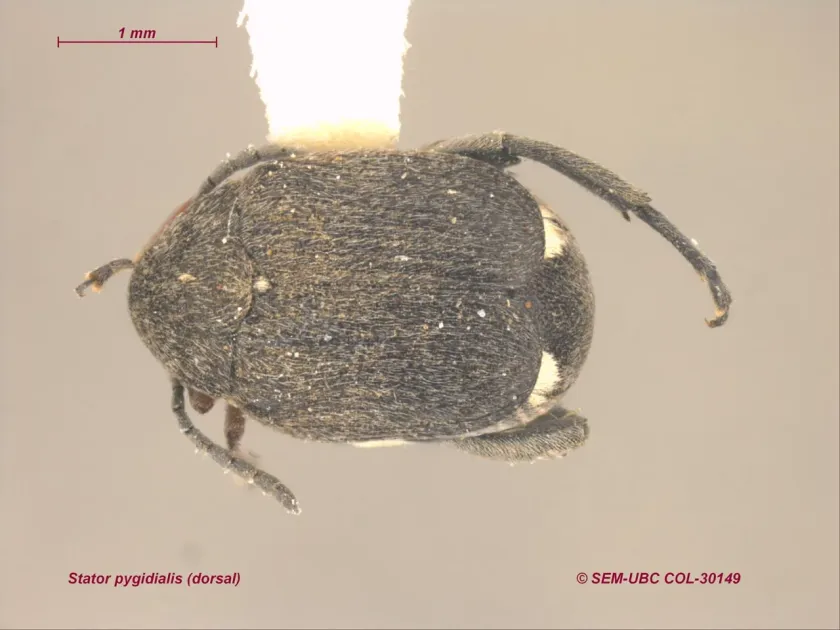
The beetle Stator pygidialis belongs to the Bruchidae family within the order Coleoptera. These insects are small, oval-shaped, and possess characteristic physical features that allow them to thrive in stored seeds.
Adult beetles generally exhibit dark brown to black coloration, often decorated with faint, mottled patterns on the elytra. Their heads are small and tucked beneath the pronotum, while their antennae are often serrated.
The larvae are specialized for internal feeding; they possess a white, fleshy, C-shaped body with vestigial legs, perfectly adapted to live and grow entirely within a single seed of a host plant.
Due to the morphological similarity between many species of bruchids, accurate identification often requires a detailed examination of the male reproductive structures under a microscope.
Adult beetles are capable of flight, which enables them to spread across fields and find suitable legume hosts to deposit their eggs as the plants approach maturity.
What it damages
The larvae of Stator pygidialis primarily feed on the seeds of various legumes, including both cultivated and wild species, causing significant economic damage.
By consuming the internal cotyledons and the embryo, the larvae render the seeds useless for sowing, as the germination capacity is destroyed or drastically reduced.
Marketable grain quality is severely compromised; the seeds lose weight and nutritional value, and their physical integrity is breached by the emergence holes created by the adults.
Secondary damage occurs as the debris and waste products produced by the larvae create an ideal environment for mold growth and attract other secondary storage pests.
In stored grain silos, an uncontrolled infestation can result in total loss of the batch if the environmental conditions remain favorable for the beetle's reproduction.
When it appears
The lifecycle is tightly synchronized with the maturity cycle of host legumes. Females deposit eggs on the surface of developing pods or seeds during the ripening stage.
Once the egg hatches, the larva bores into the seed, where it spends its entire developmental period feeding and passing through several larval instars before pupation.
The rate of development is heavily influenced by temperature and humidity. Under warm conditions, the time from egg to adult can be very short, facilitating multiple generations per year.
Inside heated warehouses, the beetle can maintain continuous development year-round, bypassing any seasonal diapause that might occur in colder, natural outdoor environments.
Active adults emerge from the seeds, seek out mates, and then migrate to nearby legume crops in the field to continue the cycle of infestation as the pods develop.
Signs of infestation
The most diagnostic sign of infestation is the appearance of circular emergence holes on the surface of the seeds, created when the adult beetle exits the grain.
Close inspection of the seeds often reveals tiny, oval-shaped, translucent eggs glued to the surface of the seed coat by the female beetle during the oviposition process.
Seeds infested by the larvae exhibit reduced density, and they often feel lighter when handled. Internal damage may appear as discoloration or hollow regions beneath the seed coat.
A noticeable "rustling" or movement within the grain mass in a storage container is an indicator of heavy larval activity, signaling a serious infestation level.
The presence of live or dead adult beetles on the surface of stored grain or near storage bags confirms the completion of the lifecycle and the need for immediate control.
Control measures
Preventive measures are paramount, starting with strict phytosanitary checks on incoming grain shipments to ensure they are free from eggs and larval stages of the beetle.
Regular sanitation of warehouses, including the cleaning of silos and handling equipment, is essential to disrupt the habitat and food supply of the pest.
Physical controls, such as cooling the grain to inhibit metabolic activity or using high-temperature treatments, provide effective, non-chemical ways to manage populations.
Chemical control usually involves the application of regulated fumigants that can penetrate the seeds, effectively killing larvae and adults within the grain kernels.
Good agricultural practices, such as choosing resistant varieties, implementing appropriate crop rotation, and harvesting early, can significantly reduce the risk of field infestation.
Taxonomy
- Latin name
- Stator pygidialis
- Order
- Coleoptera (beetles)
- Family
- Bruchidae
- EPPO code
- STAOPY
Discussion
No discussions yet — be the first.