
Stator pruininus
Stator pruininus
Description
How to identify
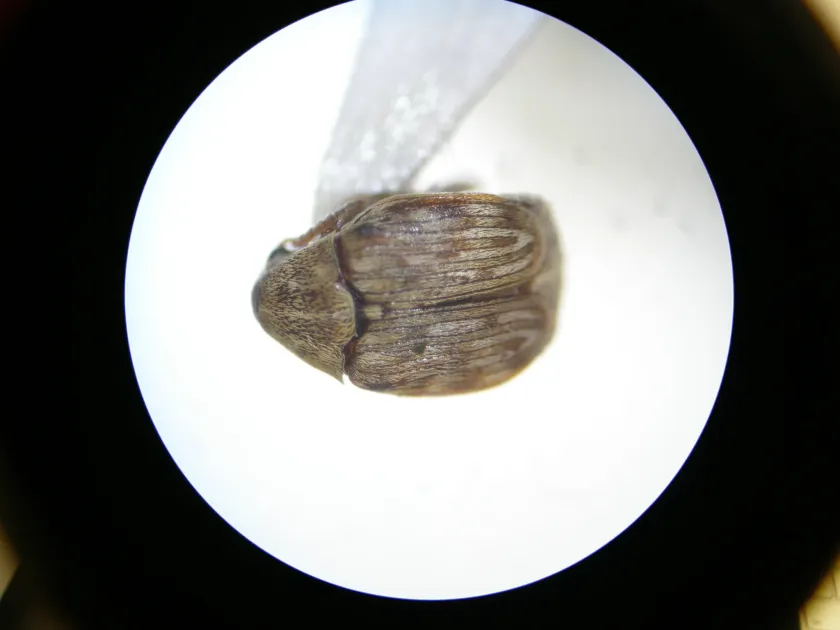
Stator pruininus belongs to the order Coleoptera and the family Bruchidae. This small insect has an oval body, approximately 3–4 mm long, covered with dense hairs that give it a characteristic matte grey or brownish appearance.
Adult beetles possess well-developed wings, allowing them to migrate actively in search of suitable oviposition sites. The head is relatively small with serrated antennae, which is a hallmark of this subfamily of seed beetles.
The larvae of Stator pruininus are cream-white, legless, and adapted for a cryptic life inside the seed. After passing through several developmental stages, they pupate directly within the damaged seed, eventually emerging as adults.
Accurate identification of the species often requires examination of the male genitalia, as many members of the genus Stator appear morphologically similar to the naked eye. The structure of larval chambers within legume pods is also a key diagnostic feature.
Monitoring the population levels in warehouses or fields often involves the use of pheromone traps, which help detect the presence of this pest long before visible damage becomes apparent.
What it damages
The primary host plants for this species are legumes (Fabaceae). They frequently infest both wild and cultivated plant species, including members of the Acacia and Prosopis genera, as well as various agricultural pulse crops.
Larvae bore into the developing seeds, where they feed on the embryo and cotyledons. This leads to a significant loss of grain weight and total loss of seed viability, rendering the product unsuitable for planting.
Beyond direct grain destruction, the pest compromises the quality of produce intended for human consumption by contaminating it with frass and larval remnants. Infested stocks can quickly deteriorate in storage due to secondary infections.
International trade in grain and legumes often acts as a pathway for the spread of Stator pruininus. Because it is easily transported with shipments, it is considered a potential quarantine pest in many countries.
In cases of high infestation, crop losses can account for a significant percentage of total volume, especially when grain is stored in facilities lacking proper temperature and humidity controls.
When it appears
The development cycle of the pest is highly dependent on environmental conditions. In the field, reproduction begins when legume fruits start forming, as females lay eggs directly on the surface of the pods.
Warm temperatures and moderate humidity levels are optimal for rapid development. Under favorable conditions, one generation can complete its cycle in 30 to 45 days.
In regions with cold winters, Stator pruininus is more commonly found in storage facilities, where temperatures are maintained at levels sufficient for continuous breeding throughout the year.
Adult migration to fields occurs during the spring and summer. The beetles feed on the pollen and nectar of various plants until the legume fruits become available for egg-laying.
The adult lifespan is typically several weeks, during which a single female can lay dozens of eggs on the surface of seeds or pods.
Signs of infestation
The most prominent sign of infestation is the presence of circular exit holes on the surface of legume seeds. These holes are created by adults as they emerge from the seed after completing their development.
Under close inspection with a magnifying glass, one can identify tiny eggs glued to the seed coat. These eggs appear as minuscule, slightly raised spots, often grouped together in clusters.
Inside infested seeds, there are cavities filled with floury waste (frass) and larval skins. The affected seed becomes lightweight, brittle, and loses the natural luster of its coat.
A characteristic auditory sign in heavily infested storage bags is a soft rustling sound, produced by the movement of a large number of active beetles.
- Presence of exit holes in seeds.
- Reduced germination rates in seed viability tests.
- Accumulation of dust and excrement in containers.
- Visual presence of adult beetles on the grain mass.
Control measures
The primary defense strategy involves strict quarantine measures for all imported pulse shipments. Thorough fumigation of grain batches prior to transport is effective in preventing the spread of the pest.
In storage environments, maintaining high hygiene standards and low temperatures (below 10 degrees Celsius) can significantly slow down or halt the developmental cycle of the beetles.
Contact insecticides are restricted for use only in empty storage facilities or on equipment, as direct application to food grain is strictly regulated and often prohibited by food safety standards.
Biological control methods, such as the use of parasitic wasps, have shown promise in laboratory settings, though large-scale industrial application is currently limited by technical challenges.
Before storing grain, it should be dried to a moisture content of less than 12 percent, which creates an unfavorable environment for the survival and development of seed beetle larvae.
Taxonomy
- Latin name
- Stator pruininus
- Order
- Coleoptera (beetles)
- Family
- Bruchidae
- EPPO code
- STAOPR
Discussion
No discussions yet — be the first.