
Brazilian bean weevil
Pseudopachymerus brasiliensis
Description
How to identify
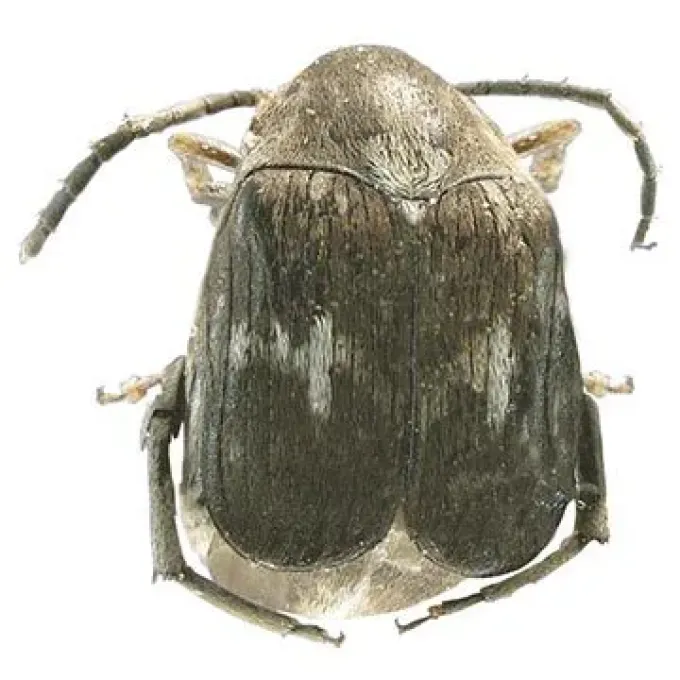
The Brazilian bean weevil Pseudopachymerus brasiliensis belongs to the family Bruchidae, order Coleoptera. This beetle is characterized by a robust body and elytra that do not fully cover the abdomen, which is a typical feature of seed beetles.
Adults are small, generally dark brown, and often display distinct light-colored patterns on their wing covers. The head is relatively small, retracted into the prothorax, and the antennae show a serrated or comb-like structure.
The larvae are white, grub-like, and curved, specifically adapted to survive and feed inside the seeds of leguminous plants. They possess strong mandibles capable of penetrating even the hardest seed coats.
As strong flyers, these beetles can easily infest new areas and storage facilities. Their biology is deeply integrated with the seasonal availability of their host plants, which include various species of beans and ornamental legumes.
In temperature-controlled storage environments, this species can maintain continuous breeding cycles, significantly increasing the risk of rapid population growth throughout the entire year.
What it damages
The primary hosts for this pest include a wide range of leguminous seeds, including various acacia species and other beans. Larval development occurs entirely within the seed, where they consume the embryo and endosperm.
In warehouse conditions, the Brazilian bean weevil can destroy large quantities of seed stocks. The damage reduces germination capacity to near zero, making the seeds completely unsuitable for planting purposes.
Beyond physical consumption, the larvae generate waste products and debris within the grain mass. This contamination degrades the quality and market value of the stored produce, often rendering it unusable for food or animal feed.
The biological activity of these beetles increases local moisture content within the storage mass, which promotes the growth of storage molds and may lead to overheating of the stored seeds.
If not managed, the cumulative impact of these infestations can lead to total loss of stockpiled agricultural products, as the beetle population reproduces exponentially within enclosed environments.
Signs of infestation
The most common sign of an infestation is the presence of small, perfectly circular emergence holes on the surface of the seeds, which occur when the adult beetle leaves the host seed.
One can often observe tiny, oval-shaped eggs glued to the exterior of the seeds. Early detection of these eggs allows for intervention before the larvae burrow deep inside the seed tissue.
The presence of adult beetles crawling on storage surfaces, sacks, or bins is a clear indicator of an active infestation. In quiet environments, one might even hear the rustling sounds of larvae activity.
Accumulated dust and powdery debris around seed containers often consist of waste and larval excrement. This accumulation is a sign that the larvae have been feeding intensely for a period of time.
Seeds affected by heavy infestations become light and hollow, and they often crumble when handled. Regular X-ray analysis or destructive sampling is required to detect early larval stages before emergence holes appear.
Control measures
Effective management begins with strict sanitation practices. Before stocking new grain, all storage areas must be thoroughly cleaned to remove residues and treated with approved insecticides to eliminate dormant populations.
Fumigation is the most reliable method for controlling infestations already present inside seeds. Using specialized gaseous treatments allows for deep penetration into the grain mass to reach larvae hidden within the seeds.
Controlling the storage environment is essential; maintaining dry conditions and low temperatures significantly limits the metabolic activity and reproductive rate of the Brazilian bean weevil.
Implementing a strict quarantine for all incoming seed shipments is crucial. The use of pheromone traps serves as a highly effective tool for early detection of beetle activity in warehouses.
- Complete cleaning of storage facilities to remove dust and debris.
- Use of hermetically sealed storage bags to isolate infested batches.
- Regular temperature and moisture monitoring of stored stocks.
- Fumigation of infested consignments by trained professionals.
- Strategic use of monitoring traps to track beetle populations.
Taxonomy
- Latin name
- Pseudopachymerus brasiliensis
- Order
- Coleoptera (beetles)
- Family
- Bruchidae
- EPPO code
- PSPCBR
Discussion
No discussions yet — be the first.