
Bean weevil
Pseudopachymerus
Description
How to identify
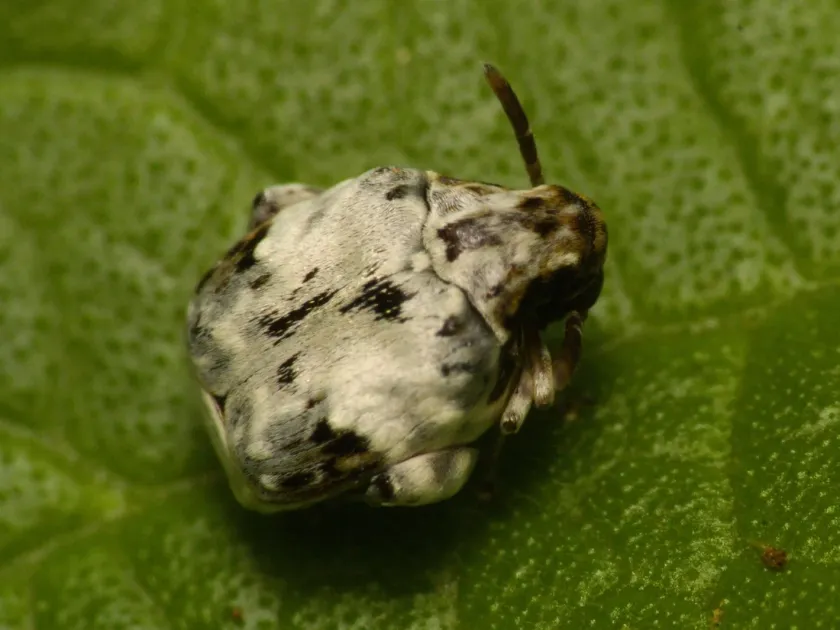
The bean weevil (Pseudopachymerus) belongs to the family Bruchidae within the order Coleoptera. This insect is characterized by a compact, oval-shaped body protected by a thick chitinous shell, often covered with fine hairs.
Adult specimens usually display brown, gray, or black tones, which provide excellent camouflage on the surface of seeds. They possess well-developed antennae that assist in navigating when searching for suitable sites to deposit eggs.
The larvae of this pest are whitish and legless, with a physical structure perfectly adapted for feeding on the internal tissues of seeds. The body of the larva is curved, allowing them to move efficiently inside the seed cavity.
The insect's development is closely linked to the seeds of legume crops, within which the entire life cycle from egg to adult occurs. This species prefers specific climatic conditions typical of warmer regions.
This species can be distinguished from other stored-grain weevils by the specific shape of the pronotum and the structure of the hind femora, which feature characteristic teeth, essential for precise diagnostic by entomologists.
What it damages
The primary food source for bean weevil larvae is the seed of various legume crops. The insect causes the most significant damage in warehouses and storage facilities where optimal breeding conditions exist.
The pest destroys planting material, leading to a critical reduction in seed germination energy. Larvae consume the embryo and nutrients inside the seed, making it completely unsuitable for planting.
In cases of mass infestation, pulse stocks become dangerous even for use in animal feed. The presence of excrement and larval residues inside the seeds promotes the development of mold and other pathogenic microorganisms.
Beyond the direct destruction of endosperm, the weevil causes temperature spikes within the grain bulk. This creates additional risks of self-heating and total loss of the batch during long-term storage.
Economic losses arise not only from the loss of grain mass but also from the need for expensive fumigation of facilities. Furthermore, the market value of the product drops significantly due to the damaged appearance of the seeds.
When it appears
The development cycle of the bean weevil directly depends on the ambient temperature. In heated storage facilities, the pest can continue its development throughout the year without a distinct dormancy period.
Optimal temperatures for active reproduction of the insect range from +20 to +30 degrees Celsius. When temperatures drop below +10 degrees, vital processes slow down or temporarily cease.
The female deposits eggs directly on the seed surface or into microscopic cracks in the shell. Upon hatching, the larva bores its way inside, making it inaccessible to most contact insecticides.
The duration of one generation varies from a few weeks to several months, depending on air humidity. High seed moisture levels accelerate the pest's metabolism and lead to rapid population growth.
In the natural environment, the emergence of adults is observed during the pod-forming period of legume plants. However, the species poses the greatest danger during crop storage, where pest density reaches its maximum.
Signs of infestation
The first visual sign of infestation is small holes on the surface of legume seeds. These are the exit points where larvae have completed their development and emerged as adults.
When inspecting grain batches, one can observe the presence of "windows"—translucent areas of the seed coat under which the larva hides. This is evidence that the grain destruction process is currently ongoing.
A characteristic sign is the presence of whitish spots on the seed surface, which are the pest's eggs. They are often glued to the skin and can be seen upon careful examination with a magnifying glass.
Infested batches often have a specific musty odor caused by the accumulation of larval waste. Increased dustiness may also be observed when the grain is being moved or poured.
When weighing infested products, a significant decrease in grain density is noted. Hollow seeds become very light and are easily separated from healthy mass during air-stream cleaning.
Control measures
The basis of control is adherence to strict sanitary standards in storage facilities. Regular cleaning of warehouses to remove dust and remnants of the previous harvest prevents the formation of breeding clusters.
Before placing grain in storage, it is necessary to thoroughly dry it to a moisture level below 12-14%. In dry seeds, the development of weevil larvae is significantly slowed or completely halted.
To protect seed material, thermal methods such as heating or freezing are applied. These physical techniques allow for the destruction of all pest stages without the use of chemical crop protection agents.
In cases of large-scale warehouse infestation, fumigation with phosphine-based gases is performed. This procedure requires highly qualified personnel and strict compliance with safety regulations.
- Mandatory sealing of premises before fumigation.
- Use of pheromone traps for population monitoring.
- Quarantine inspection of all incoming grain batches.
Taxonomy
- Latin name
- Pseudopachymerus
- Order
- Coleoptera (beetles)
- Family
- Bruchidae
- EPPO code
- PSPCSP
Discussion
No discussions yet — be the first.