
Tonkin bruchid
Megabruchidius tonkineus
Description
How to identify
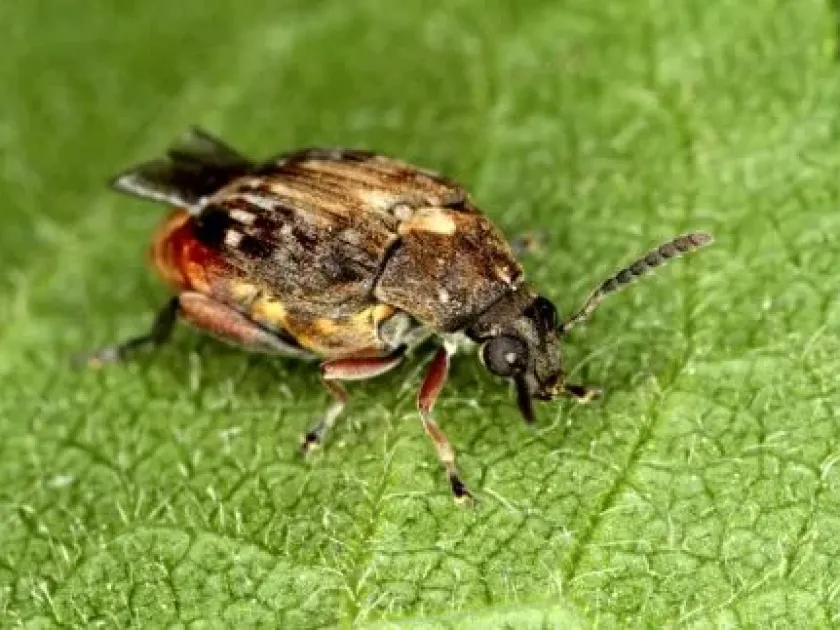
The Tonkin bruchid (Megabruchidius tonkineus) is a beetle belonging to the family Bruchidae. Adult specimens are small, typically measuring 3–4 mm in length, with an oval-shaped body.
The insects are distinguished by a dense covering of hairs on their elytra, which often creates a mottled or patterned appearance. Their antennae are serrated or slightly comb-like.
Larvae are legless, white in color, and feature a robust, sclerotized head capsule equipped with strong mouthparts designed for boring into hardened seeds.
The identification of this species is complex due to its morphological similarity to other bruchid beetles; microscopic examination of male genitalia is often necessary for accurate classification.
This beetle is highly adaptable, allowing it to survive in various environments and spread efficiently through the trade and movement of host seeds.
What it damages
The primary host for the Tonkin bruchid is the honey locust (Gleditsia triacanthos). Larvae feed internally on the seeds, consuming the embryo and endosperm.
The main agricultural impact is a dramatic reduction in seed viability, which is catastrophic for commercial nurseries and reforestation projects that rely on high-quality seeds.
In cases of high infestation, the pest can destroy the vast majority of a tree's annual seed production, leading to significant economic losses in the forestry sector.
Infested seeds are prone to secondary infections, such as mold, and their structural integrity is severely compromised, rendering them useless for germination.
The presence of this pest also triggers strict phytosanitary regulations, creating barriers to the trade and transport of legume seeds between regions or countries.
When it appears
The life cycle of the Tonkin bruchid is closely synchronized with the phenology of the honey locust tree. Adults emerge during the summer months when pods are maturing.
Females deposit eggs directly onto the surface of developing pods. A single female can produce multiple eggs, ensuring that an entire pod cluster becomes heavily infested.
Upon hatching, the larvae burrow through the pod shell and enter the seeds to begin their feeding cycle, which lasts for several weeks until pupation.
Overwintering typically occurs in the larval or pupal stage inside the seeds, either on the tree or on the ground, protecting the insect from harsh winter conditions.
When temperatures rise in the spring, the adult beetles emerge by boring circular exit holes, completing the life cycle and starting a new generation.
Signs of infestation
The first indicator of infestation is the appearance of small, whitish eggs on the exterior of developing seed pods during the summer growing season.
Later in the season, the presence of distinct, perfectly circular exit holes on the surface of mature seeds is a definitive sign of successful larval development.
If a damaged seed is dissected, one will typically find a hollow interior filled with frass (insect excrement) and the remains of the consumed seed embryo.
Early-stage damage may be indicated by localized discoloration or slight deformation of the seed pod surface where larvae have initiated their entry.
In stored seed batches, one might detect adult beetles crawling on the surface or find piles of fine dust near the storage containers.
Control measures
The most effective cultural practice is the consistent collection and destruction of fallen pods, which serves to remove primary reservoirs for overwintering populations.
For high-value seed stocks, chemical control via insecticide spraying during the peak adult flight period can prevent oviposition on the ripening pods.
Fumigation is the standard method for managing infestations in stored seed lots; however, this must be conducted by professionals to ensure safety and effectiveness.
Maintaining low temperatures in storage facilities can significantly inhibit the development rate of larvae and prevent multi-generational outbreaks.
- Monitor populations using pheromone or light traps.
- Implement strict quarantine protocols for imported seed shipments.
- Encourage natural predators and parasitoids in forested areas to manage beetle numbers.
Taxonomy
- Latin name
- Megabruchidius tonkineus
- Order
- Coleoptera (beetles)
- Family
- Bruchidae
- EPPO code
- MBRCTK
Discussion
No discussions yet — be the first.