
Gleditsia seed beetle
Megabruchidius dorsalis
Description
How to identify
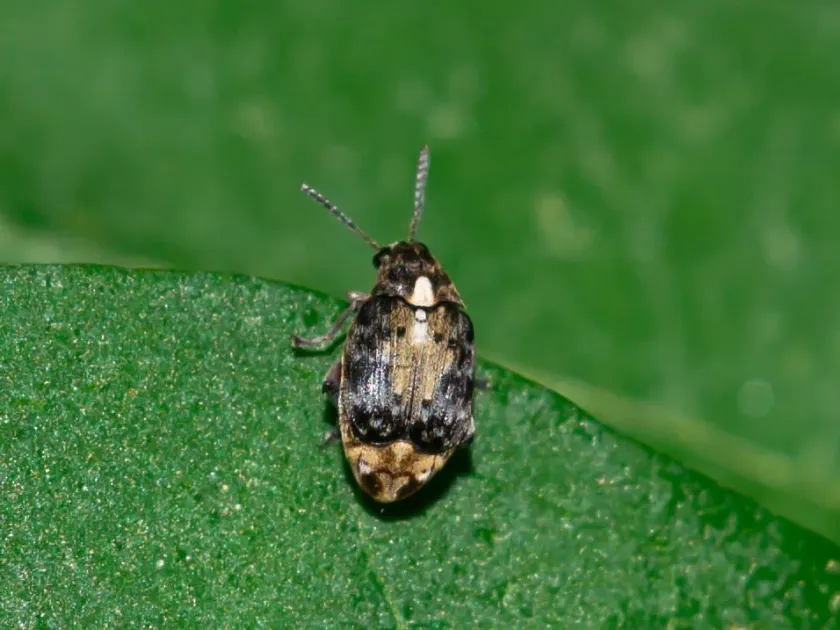
The Gleditsia seed beetle (Megabruchidius dorsalis) is a member of the seed beetle family (Bruchidae) within the order Coleoptera. Adult beetles are small, typically ranging from 3 to 4 mm in length, with an oval body shape covered in fine brown or grayish hairs.
The species is highly specialized, feeding exclusively on the seeds of the Gleditsia genus. The insect has a small head retracted into the prothorax, which is a characteristic feature of the family. The eyes are deeply notched, and the antennae consist of 11 segments, slightly thickened towards the tip.
Larvae are legless, cream-colored, and develop entirely inside the host plant's seeds. Due to their concealed lifestyle, detecting larvae at early stages is nearly impossible without opening the fruit pod.
The pupal stage also occurs within the damaged seed. The entire metamorphosis takes place inside the closed environment of the legume pod, providing the pest with significant protection from external environmental factors and most natural predators.
This species is considered invasive in many European regions, where it was introduced from Asia along with plant materials. Its presence is now commonly documented in areas where Gleditsia triacanthos is grown, where it spreads actively.
What it damages
The primary host plant for Megabruchidius dorsalis is the honey locust (Gleditsia triacanthos). Both adults and larvae focus on the tree's fruit, utilizing seeds as the sole source of nutrition and a nursery for their offspring.
The pest does not attack other types of legume crops, making it a highly specialized phytophage. However, in nursery conditions where Gleditsia is grown for decorative purposes or forest restoration, the damage caused by these insects can be substantial.
The destruction of seeds significantly reduces the biological productivity of Gleditsia stands. Since seeds are the primary reproductive organ of the tree, massive infestation by the seed beetle prevents natural regeneration in forest ecosystems.
Once damaged, seeds lose their viability, making them unsuitable for forestry and gardening use. Multiple larvae can develop in a single pod segment, completely consuming the contents of the seeds and leaving only hollow shells behind.
The economic impact of the pest increases when high-quality seed collection is required. Infested batches must be subjected to special treatment or completely discarded, resulting in direct financial losses for nurseries and seed producers.
When it appears
The life cycle of the seed beetle is closely linked to the phenology of Gleditsia trees. The emergence of adult beetles from overwintered seeds usually coincides with the start of the plant's flowering period or the formation of young fruit ovaries.
Adult flight continues throughout the summer as long as pods suitable for oviposition are present on the trees. Females deposit eggs directly onto the surface of young pods, securing them with a specialized secretion.
Upon hatching, the larva bores through the pod wall and penetrates the seed, where it remains until development is complete. In warmer climates, the pest can produce several generations within a single growing season.
The pest overwinters in the larval or pupal stage inside seeds that either remain on the tree or fall to the ground. As spring temperatures rise, the insects complete their development, emerge as adults, and bore exit holes in the pods.
Temperature regimes play a critical role in the rate of beetle reproduction. A hot summer facilitates faster development for each generation, leading to an exponential increase in the population by the end of the season.
Signs of infestation
The most evident sign of infestation is the presence of small, circular exit holes on the surface of mature Gleditsia pods. Through these holes, adult beetles exit the seeds after completing their metamorphosis.
Opening the pods reveals internal cavities within the seeds filled with larval excrement and debris. Seeds may appear deformed or show signs of premature drying due to the destruction of internal tissues.
In field conditions, trees with high levels of infestation may appear weakened if a significant portion of the seed crop is consumed. Premature shedding of underdeveloped or infested pods is also a common observation.
Occasionally, tiny spots on the surface of young pods may be observed—these are traces left by females during the oviposition process. However, noticing these signs without a magnifying glass is extremely difficult due to their small size.
The presence of large numbers of beetles in the tree canopy mid-summer also indicates high population activity. Pest activity is often accompanied by the presence of hollow pods hanging on branches well into late autumn.
Control measures
The primary control method in nurseries is the timely collection and disposal of fallen Gleditsia pods, which may harbor larvae and pupae. This interrupts the life cycle and reduces population numbers for the following season.
Chemical protection includes the application of systemic or contact insecticides during the period of mass flight and egg-laying. Treatments must be synchronized with the phenological phases of the Gleditsia tree.
To protect seed batches intended for storage or planting, fumigation in specialized airtight chambers is used. This method effectively destroys hidden pest stages without compromising the viability of the seeds.
Agrotechnical controls play a significant role: maintaining spatial isolation between new plantings and older, infested trees. When establishing a nursery, it is essential to thoroughly inspect seed materials for exit holes.
Biological control methods, such as the use of natural enemies, are currently being studied, though their application is limited by the species' high specialization. In some cases, planting resistant Gleditsia cultivars is recommended if such varieties are identified through breeding programs.
Taxonomy
- Latin name
- Megabruchidius dorsalis
- Order
- Coleoptera (beetles)
- Family
- Bruchidae
- EPPO code
- MBRCDO
Discussion
No discussions yet — be the first.