
Megabruchidius
Megabruchidius
Description
How to identify
Megabruchidius is a genus of beetles belonging to the family Bruchidae (seed beetles) within the order Coleoptera. These insects are well-known as specialized seed-feeders, primarily associated with the seeds of leguminous trees and shrubs.
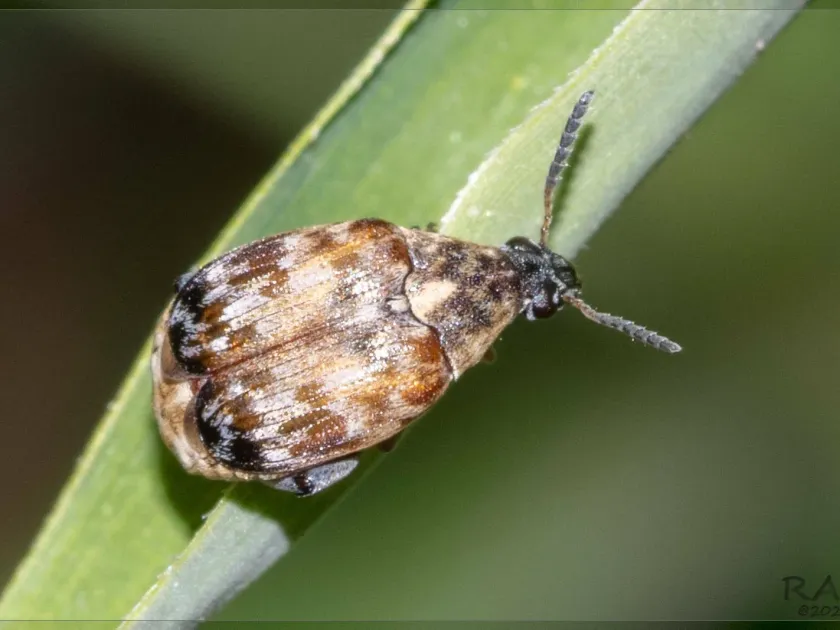
Adult beetles are relatively small, typically oval-shaped, and covered with fine hairs, which often provide camouflage against the surface of their host seeds. Their heads are usually pointed downward, and they possess characteristic serrated antennae.
The larvae are endophagous, meaning they develop exclusively within the seeds of the host plant. They are typically C-shaped, legless, and white, adapted for life in the confined environment inside the seed coat.
Proper identification to the species level often requires microscopic examination of the male genitalia. Because many species within the genus look similar, professional entomological identification is necessary for accurate diagnosis.
The distribution of Megabruchidius has expanded globally due to the movement of ornamental and leguminous plants. They are currently considered a relevant pest in many urban forestry and nursery settings.
What it damages
The primary damage caused by Megabruchidius involves the consumption of the embryo and endosperm of the seeds of leguminous plants, such as Gleditsia and Acacia species.
Larvae bore into the developing seeds, completely hollowing them out. This activity results in the total loss of the seed's viability, making it useless for propagation or forestry regeneration programs.
In cases of high infestation rates, the majority of the annual seed crop can be destroyed. This poses a significant economic threat to nurseries and seed orchards that rely on healthy seed stocks.
Furthermore, the exit holes created by the emerging adults serve as entry points for secondary infections, such as mold and fungi, which further degrade the quality of the remaining seed material.
Because the larvae remain hidden inside the seed throughout their development, the initial stages of infestation are often invisible, allowing the pest to spread undetected during trade and transport.
When it appears
The life cycle of Megabruchidius is closely synchronized with the phenology of its host plants. Adult activity usually commences during the flowering and fruit-setting period of the host tree.
Females lay eggs directly onto the surface of developing pods. Upon hatching, the first-instar larva drills through the pod wall and into the seed, where it remains until it completes its metamorphosis.
Depending on environmental temperatures, one or more generations may occur per year. Warm climates significantly shorten the development time, potentially leading to explosive population growth.
Overwintering typically occurs as larvae or pupae within the infested seeds that have fallen to the ground or remain in the pod canopy. This survival strategy is highly effective in temperate climates.
Adult emergence is often seasonal, coinciding with the maturation of the next crop of seeds, providing a continuous cycle of re-infestation for the host population.
Signs of infestation
The most distinctive sign of a Megabruchidius infestation is the presence of perfectly round exit holes on the surface of seeds, left behind by the emerging adult beetles.
Early signs include tiny, darkened spots on the seed coat, which represent the entry point of the young larva or the oviposition site of the female beetle.
If a suspected seed is opened, one can find the larva, pupa, or adult inside, along with frass (insect excrement) which appears as fine, light-colored dust filling the interior cavity.
Infested seeds are significantly lighter in weight compared to healthy ones. A simple flotation test can be used: infested seeds will often float in water due to the internal cavity left by the pest.
The presence of small adult beetles resting on or around the pods during the late summer months is a strong indicator of an active reproductive cycle in the area.
Control measures
Sanitation is the most effective management tool. Collecting and destroying fallen pods and seeds before the beetles emerge can significantly reduce the local population density.
- Remove and dispose of infested seed pods from the vicinity of nurseries.
- Apply heat treatment (kiln drying) to seeds meant for planting to kill larvae and pupae within the seed coat.
- Use cold storage for seed banks to inhibit the development and reproduction of the beetles.
- Implement strict quarantine measures for the movement of legume seeds between different geographic regions.
In nursery environments, systemic insecticides may be used if infestation levels threaten the viability of the entire crop, though timing with the oviposition period is critical.
Monitoring using pheromone traps can help track the flight period of adults, allowing for better-timed interventions and targeted control efforts.
Taxonomy
- Latin name
- Megabruchidius
- Order
- Coleoptera (beetles)
- Family
- Bruchidae
- EPPO code
- MBRCSP
Discussion
No discussions yet — be the first.