
Kytorhinus
Kytorhinus
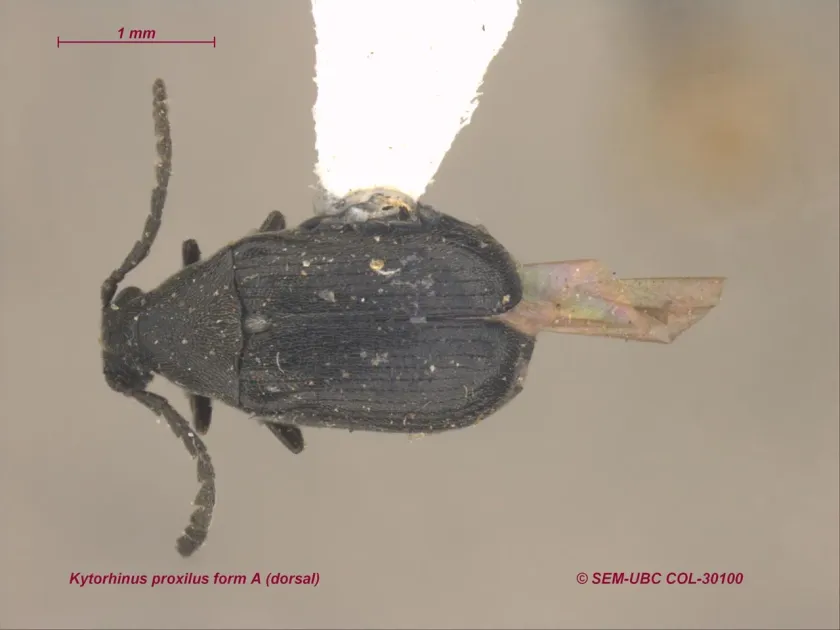
Description
How to identify
Kytorhinus is a genus of beetles belonging to the Bruchidae family, commonly known as seed beetles. These insects typically measure 3 to 5 millimeters in length and possess an oval body shape covered in fine hairs.
The head is relatively short and features robust mandibles designed for piercing the hard seed coats of various legume crops. Their elytra (wing covers) are dense and often exhibit a mottled appearance due to patches of light and dark setae.
Larvae of Kytorhinus are C-shaped, legless, and whitish in color with a distinctive brown head capsule. They are strictly endophagous, meaning they spend their entire developmental period inside the host seed.
Adult beetles are strong flyers, enabling them to locate host plants effectively during the flowering and seed-setting stages. They are highly active during warm, sunny weather, which facilitates mating and oviposition.
The genus includes numerous species globally, each adapted to specific host plants, primarily within the Fabaceae family, inhabiting diverse ecological niches.
What it damages
Kytorhinus species primarily infest legumes, including various wild species of Caragana and Astragalus, as well as cultivated crops that are economically important.
The damage is caused primarily by the larvae, which bore into the seed and consume the embryo and endosperm, effectively destroying the viability and nutrient content of the grain.
Heavy infestations lead to significant yield losses and render the seeds unsuitable for sowing, as the germination rate drops sharply once the seed embryo is consumed.
The feeding activities of the larvae compromise the integrity of the seeds, making them susceptible to secondary infections by molds, fungi, and bacteria, particularly in humid storage conditions.
Infested batches of seeds exhibit reduced market value, poor structural integrity, and often show signs of fragmentation during harvesting and processing operations.
When it appears
The activity of adult Kytorhinus beetles typically begins in the late spring and summer, coinciding with the reproductive phenology of their host plants.
Females lay their eggs on the surface of young pods. Upon hatching, the neonate larvae immediately penetrate the pod wall and the underlying seed to begin their feeding cycle.
The life cycle can vary from a few weeks to several months depending on ambient temperatures and the nutritional status of the host seeds, with multiple generations possible in warmer climates.
Pupation occurs entirely within the seed. Once the transformation to the adult stage is complete, the beetle chews an emergence hole through the seed coat to leave the seed.
Adults overwinter in protected environments, including debris, under bark, or within infested seed stocks stored in warehouses, waiting for favorable conditions to emerge.
Signs of infestation
The most diagnostic sign of a Kytorhinus infestation is the presence of perfectly round exit holes on the seed surface, left by emerging adult beetles.
In the field, one can observe adult beetles resting on flowers or developing pods. Monitoring these areas during the flowering period is crucial for early detection.
During harvesting, the presence of seed dust and fragmented, hollowed-out seeds is a clear indicator that the crop has been heavily colonized by seed beetles.
In stored grains, a distinct rustling sound may be audible when beetles are active within the batch, and local heating of the seed pile may occur due to larval metabolic activity.
A simple examination of seed samples by cutting or using a magnifying lens can reveal the internal damage and confirm the presence of larvae at various growth stages.
Control measures
Effective management begins with rigorous cultural practices, such as deep plowing of fields post-harvest to bury infested debris and disrupt the life cycle of the pest.
Crop rotation remains a fundamental strategy to prevent the buildup of pest populations in specific areas, ensuring that the host plants are not consistently available to the beetles.
- Mechanical cleaning and sieving of seeds to remove infested, lighter-weight grains.
- Cold or heat treatment of stored seeds to eliminate hidden larval stages before long-term storage.
- Application of approved insecticides during the peak of adult beetle activity if thresholds are exceeded.
Early-maturing crop varieties can often escape the peak infestation window of the pest, as the seeds reach maturity before the beetle population reaches its maximum density.
Maintaining low humidity levels in grain stores inhibits the development of both the beetles and associated fungal pathogens, preserving the quality of the harvested produce.
Taxonomy
- Latin name
- Kytorhinus
- Order
- Coleoptera (beetles)
- Family
- Bruchidae
- EPPO code
- KYTOSP
Discussion
No discussions yet — be the first.