
Silky bean weevil
Euspermophagus sericeus
Description
How to identify
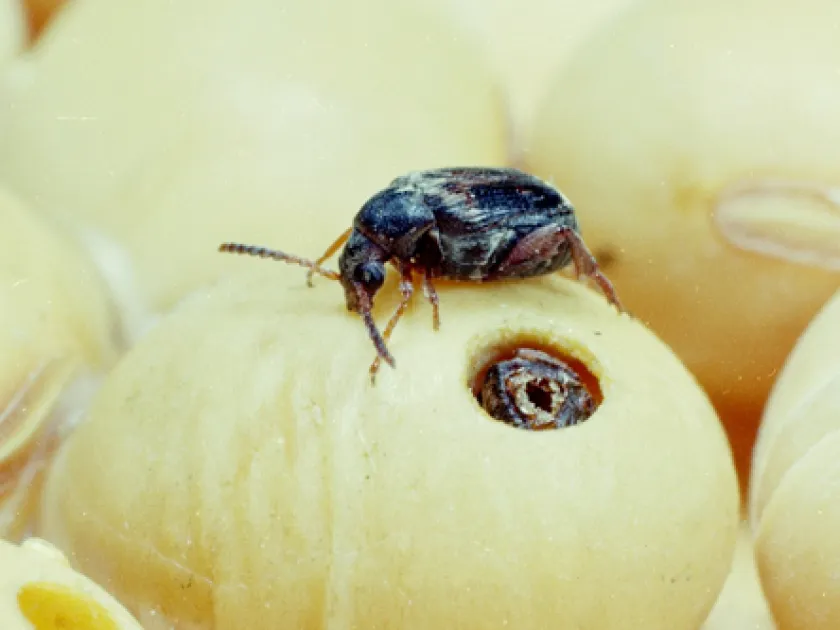
The silky bean weevil (Euspermophagus sericeus) belongs to the seed beetle family (Bruchidae) within the order Coleoptera. Adult beetles are small, measuring 2 to 3 mm in length, with bodies covered in dense hairs that provide a distinct, silky appearance.
The coloration of the imago ranges from dark brown to black. The elytra are decorated with an indistinct light pattern formed by the hair. The pronotum is narrowed anteriorly, and the hind femora possess a characteristic tooth, which serves as a vital diagnostic feature for identification under a microscope.
The larva of this pest follows the typical morphology of seed beetles: it is stout, whitish, and C-shaped, with a well-developed head capsule during early development stages. It leads a concealed life, completing its entire development inside the host plant's seed.
The pupa is exarate and usually light-colored, developing directly inside the infested seed. The insect's life cycle is closely synchronized with the maturation period of cultivated and wild legume species.
This species is a typical representative of the entomofauna specializing in seeds of the Fabaceae family and is frequently encountered in fields within warmer climatic zones.
What it damages
The primary food source for the silky bean weevil is members of the legume family (Fabaceae). It causes the most significant damage to the seeds of fodder and wild legumes, including vetch, grass pea, and other species grown in fields or stored in granaries.
Larvae feed on the interior content of the seed, consuming both the endosperm and the embryo. This results in the complete loss of seed germination capacity and a significant reduction in the mass of commercial grain.
In field conditions, infestation begins during the pod formation phase, when adult females oviposit directly onto the surface of the soft pods. As the larva grows, it bores into the seed.
Mass reproduction of the pest can lead to a 30–50% loss of seed yield, especially under unfavorable storage conditions where the insect's life cycle may continue in confined spaces.
Damage is manifested not only in the quantitative loss of grain weight but also in the degradation of quality, as the exit holes created by the beetles facilitate the growth of mold fungi and the accumulation of toxins.
When it appears
The activity of adult silky bean weevils begins in the spring when ambient temperatures reach optimal levels for the beetles to emerge from overwintering sites, such as warehouses or plant debris.
During the flowering and pod-formation stages of host plants, the beetles migrate to the fields. Females actively lay eggs on the surface of young pods, marking the beginning of the generation cycle under field conditions.
The development of one generation during the summer lasts between 30 and 45 days, depending on temperature and air humidity. Under favorable conditions, several generations can develop in a single season.
In autumn, new generation beetles migrate to overwintering sites or remain within infested seeds located in granaries. In storage environments, pest development can proceed year-round if temperatures remain above freezing.
The most critical period is the seed filling stage, as mass egg-laying occurs during this time, directly determining the infestation level of the upcoming harvest.
Signs of infestation
The primary sign of the pest's presence is the appearance of small, round exit holes on the surface of the legume seeds. Occasionally, tiny, flat eggs resembling scales can be spotted on the seed coat.
Upon opening the seed, internal cavities are discovered, filled with larval waste products (frass) and remnants of damaged tissue, which gives the seeds an unpleasant odor and appearance.
- Presence of round exit holes on seeds.
- Reduction in specific weight of grain batches during inspection.
- Presence of adult beetles in storage areas or fields during maturation.
- Significant decrease in germination during laboratory testing.
Infested seeds are easily identified during sorting because they have a lower density and often float when submerged in water, unlike healthy, full seeds.
Under heavy infestation, fine dust is observed when moving seeds, caused by the destruction of the internal endosperm structure by the larvae.
Control measures
Agrotechnical control methods include strict crop rotation and spatial isolation of legume fields from the previous year's plots, which reduces the risk of beetle migration.
Timely harvesting immediately after maturation is crucial to prevent the mass emergence of beetles and the re-infestation of pods left in the field.
For stored grain, effective methods include thermal treatment (heating) or fumigation in airtight warehouses if infestation levels exceed the economic injury threshold.
Chemical control of fields involves the use of systemic or contact insecticides during the period of mass egg-laying by females, which requires precise monitoring of the plant's phenological stages.
Cleaning and drying seeds immediately after harvest significantly slows down larval development inside the grain, preserving both its seeding quality and commercial value.
Taxonomy
- Latin name
- Euspermophagus sericeus
- Order
- Coleoptera (beetles)
- Family
- Bruchidae
- EPPO code
- EUSMSE
Discussion
No discussions yet — be the first.