
Convolvulus seed beetle
Euspermophagus convolvuli
Description
How to identify
The Convolvulus seed beetle (Euspermophagus convolvuli) is a member of the Bruchidae family, which are commonly known as seed beetles or pea weevils.
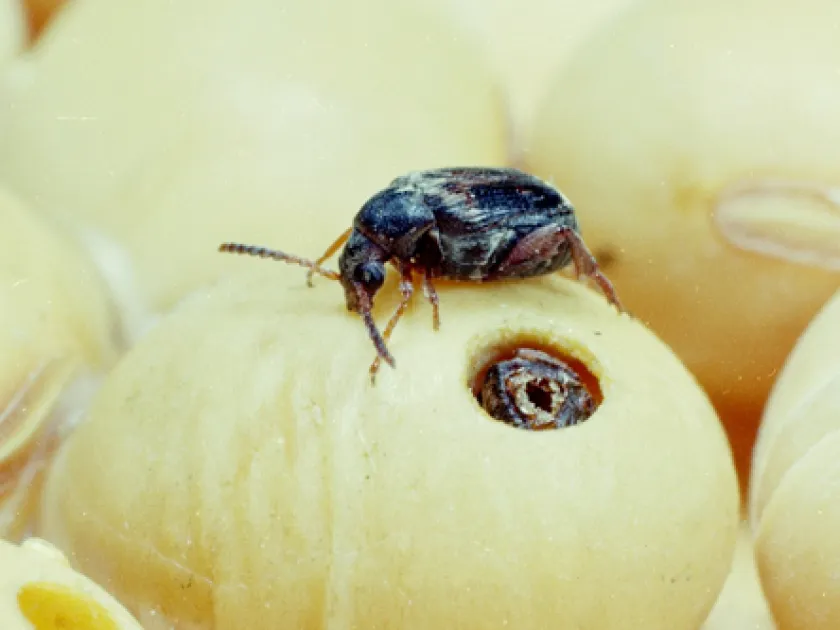
These beetles are small, typically measuring between 2 and 3 millimeters in length, with an oval-shaped body covered in dense, fine hairs.
Their coloration is generally dark brown or black, providing them with effective camouflage against the background of plant debris where they often reside.
The larvae are typically C-shaped, legless, and creamy-white, adapted for living and feeding entirely within the confined space of a single seed.
Taxonomically, they are categorized under the order Coleoptera and are specialized feeders on plants belonging to the Convolvulaceae family.
What it damages
The beetle primarily damages the seeds of the field bindweed (Convolvulus arvensis), a common and persistent agricultural weed.
The larvae burrow into the developing seeds and consume the endosperm, effectively destroying the embryo and rendering the seed infertile.
Because the larvae complete their development inside the seed, the external appearance of the seed pod may remain largely unchanged until the adult beetle emerges.
While the beetle causes significant damage to the bindweed seeds, this is often viewed as a form of natural biological control against a major weed species.
In cases of high beetle density, a large percentage of the weed's seed bank can be destroyed, though this rarely eradicates the plant completely.
When it appears
Adult beetles become active in the spring, coinciding with the flowering phase of their host plants, where they feed on pollen and nectar.
Mating occurs shortly after emergence, followed by the female depositing eggs on the surface of developing seed pods.
Upon hatching, the larvae penetrate the seed coat to reach the nutrient-rich interior, where they remain until they pupate into adults.
The entire life cycle is tightly coupled with the host plant's phenology, with development accelerating during warm summer months.
Adults overwinter in sheltered locations such as plant stems, leaf litter, or crevices in the soil, ready to emerge the following spring.
Signs of infestation
The most common sign of infestation is the presence of small, circular exit holes on the surface of dried bindweed seed pods.
When pods are opened, one may observe hollowed-out seeds or fine frass, which are the excrement and waste products left behind by the larvae.
Close inspection during the flowering season may reveal the presence of adult beetles resting on or feeding on the flowers of the bindweed.
A noticeable decrease in the overall seed weight of the bindweed population in a specific area can also indicate high levels of infestation.
Since the beetle is internal, plants may appear lush and healthy despite the significant hidden damage occurring within the reproductive structures.
Control measures
Since this beetle primarily targets a weed species, specific insecticide control is generally not recommended or practiced by farmers.
The most effective management strategy is to maintain clean fields and practice good weed control, which naturally limits the beetle's food supply.
Deep autumn plowing helps to disturb the overwintering sites of the beetles, significantly reducing the survival rate of the emerging spring population.
Crop rotation and competitive planting can further suppress bindweed growth, thereby diminishing the habitat available for the Convolvulus seed beetle.
While researchers study these beetles for their potential in biological weed control, they are currently managed primarily as a secondary effect of weed control practices.
Taxonomy
- Latin name
- Euspermophagus convolvuli
- Order
- Coleoptera (beetles)
- Family
- Bruchidae
- EPPO code
- EUSMCO
Discussion
No discussions yet — be the first.